End of File, for now
I have decided to pause my research and podcast journey. I posted a letter to my Patreon explaining the details, which I will paste below for posterity:
Hello Dear Friends,
I have bittersweet news to share: I have decided to step down from my leadership role in the Future of Coding community. I still plan to be involved, lurking in the Slack, responding to emails, helping where I can, but I will no longer be organizing events, doing research, or releasing podcasts (beyond the final few I still have in the queue).
I asked Ivan Reese, one of the first and most dedicated community members, to take my place. Not only is he an incredibly smart researcher and talented interviewer, he has excellent judgement, is kind, and thoughtful. His one guest interview (with Jack Rusher) was the best-produced and most-listened-to episode on the feed!
You’ll hear more from Ivan soon about his plans for the future of the podcast, community, and website.
Tidying up a few loose ends:
Why am I stepping down?
In the short-term: to focus on family, plan my wedding, and make a feature film with my fiance. (Out of left field, I know!)
In the longer term, I plan to come back to this work fully as an “organizer” of it, in the shape of a company, non-profit, or governmental organization. Will keep you posted!
What about my research?
I still think it’s a terribly interesting thread to pull on, and am very excited to continue to follow Conal Elliott, Adriaan Leijnse, and the denotative community. Even in my less-active state, I will be really quick to reply to all emails about this! All of my thoughts and notes will remain in futureofcoding.org/log.
What about Patreon?
Thank you so much to everyone who has supported me and our community so far! I am shutting this Patreon down. I expect Ivan to start his own in the coming months.
Thank you so much, everyone! Two and a half years ago I started talking to an empty room and all you beautiful people showed up, listened, and had so many wonderful things to add to my life, and to each others’. The world became a bigger place and a smaller place for me. For all it’s faults, the internet has allowed us all to find each other in this lonely world. It’s a magical thing having close friends who can speak to your soul that you’ve never met in person.
I better end this before I get too teary-eyed. But really, to those of you who have been my cheerleaders and biggest fans, you know who you are, please know that none of this would’ve happened without you. I am so grateful. I can’t wait to see what new heights you reach in this next chapter.
Love always,
Steve Krouse
merged
Friday Sept 27, 2019
JE Call on 9/25/19
On Wednesday I spent two hours preparing for the call with JE, thinking through my plan for a “vision statement” project. The notes from the call are here. He approved of the plan and suggested this year’s Salon de Refuge as a place to publish these notes. We agreed on next Friday, Oct 4 as the time I will send him a couple paragraphs of a plan for this project:
- my research goals, what I’m doing and why
- write the abstract to the paper I want to submit
Here are the prep notes:
-
Are there similar efforts like this? Clearly the Mother of All Demos comes to mind. But the Internet, Wikipedia, and open-source were all existence proofs. Yes some people hyped them up but it just took time for them to proof in the pudding. BV’s talks come to mind but they also have a mixed legacy. They got me (and Webflow and Notion and Explorables) so I think its net super positive.
- Markers of success
- virality: super top of HN/reddit/twitter with thousands of upvotes, retweets
- people citing it as influential to their own work (or career changes)
- friends and family better understand what I’m trying to do (more incidental)
- people want to sponsor or invest in what I’m doing (more inbound support requests)
- Goal take away messages
- something about how there are all sorts of limitations with technology that we have learned to live with but that are worth trying to fix
- a feeling that the computer revolution that has happened doesn’t live up to what can happen
- a sense of medium from speaking to writing to printing press, radio, tv, internet, social media, etc that is so key and merits focus
- wow, these are similar to https://futureofcoding.org/drafts/statement#5-year-goal!
- in other words, my new thinking is: can I demo this system without a building it? can I use my imagination to cut corners?
- Day in the life
- The problem with demo-ing using such a system without modifying it is that it feels like another app. The problem with modifying it too much is that it feels like a lot of work, when in reality the modifications happen rarely
- Some interfaces I wish existed
- I could train my phone or watch with custom voice commands, such as: “I will follow up on that” to retroactively save and remind me about the last couple minutes of conversation. Trying to solve the problem of having to pull out my phone to take notes or reminders and disconnect from the conversation.
- The ability to connect to multiple wifi networks at the same time, or dynamically switch between them based on bandwidth
- Block phone numbers based on a pattern (app for this)
- Spotify running
- mix and match bits of functionality from google apps and code
- todo list, email, amazing marvin, team project management
- CRMs, Notion, Coda
- invite list for party, expected attendance, tracking responses, seating list, analytics
- https://futureofcoding.org/drafts/ulf-2019
- expense tracking
- Other idea is to do interviews with people to get them to imagine / pretend build in Figma what interfaces they’d want
Let’s get visual! This system exists. What do I build?
The system would let me interact with my Inbox as a stream of emails of some sort. I think that the idea of an “inbox” that you try and keep to zero by either doing the thing or putting it in a bucket of whent to do it is a good strategy. All emails (accept spam or others filtered out) will go to this inbox. I will also put new todos in here that are generated in real life such as meetings. This is like emailing yourself todos. –> One way to think of this strategy is emailing yourself todos and snoozing things. That works but it doesn’t allow reordring of todos or nesting of todos or a lot of other expression. Something closer to Coda is what I want but also email within it. But you can do that with Coda! You can even view the emails one at a time in something that looks like Gmail for iPad. But it’s not nearly as nice… This is where it gets subtle. I want to be able to have everything how I want it but I don’t want to have to make it all myself. I’d like to customize building on what others have done, occasionally adding my own little customizations, mostly through composability, and occasionally through work from scratch. I think I have to bite the bullet and actually design it… Here’s a ~20 minutes of work on some sketches:

Places I drew from and shouldn’t forget when doing this work:
- https://futureofcoding.org/log#end-user–end-community-computing-vision
- https://futureofcoding.org/drafts/statement#5-year-goal
- https://futureofcoding.org/drafts/ulf-2019
Other vision statement thoughts
- How we allow for the functionality of Uber (people to exchange money for rides) without the centralized company Uber? For example, drivers can export their location, verified reviews, and a pricing function. Can we generalize for all sorts of such exchanges in a Craigslist sort of way? How do people export the type of service they provide? Do we need an ontology of services and products or can simple searching work?
- Metaphorically, Illich’s thoughts on bikes vs cars could be an interesting way to explain end-user programming vs corporate-built software. It’s similar to the metaphor I got from Dynamicland of a knife vs a Nespresso, which recently worked well on a friend.
sadded similar efforts to catalog
added dark transcript
Mon, Sep 16, 2019
Recap July 24 - Sept 16, 2019
It’s been a record 5 weeks since I’ve done a proper log entry here! Apologies to my wonderful readers. However you haven’t missed terribly much as I’ve mostly been putting the finishing touches on the Whole Code Catalog, going to a few conferences and other traveling. Here is the quick recap:
BobKonf 2019
I decided last minute to attend BobKonf colocated with ICFP in Berlin this year to see Adriaan Leijnse of “Relativistic FRP” and Conal Elliott give talks. (These are both online and well-worth watching!) I was fortunate enough to spend a couple hours with them both, talking about the future of extending FRP, particularly into the domain of distributed computing. While we didn’t speak of him directly, I started watching Paul Borrill’s videos about this time about the intersection of physics, time and distributed computing after Adriaan sent them to us, as they were instrumental in his thinking through relatavistic FRP. More on this later.
ULF and PPIG 2019
I attended a User Liberation Front meeting with Jonathan Edwards, Antranig, Luke and Marianna, Stephen Kell, and others in Cambridge before we all went to PPIG. It was wonderful seeing them all! I wasn’t as much of a fan of PPIG and ended up leaving a day early to get back to work at home.
Launching WCC
Last Monday I finally launched the Whole Code Catalog. It was definitely successful enough for me to be happy (front page of HN for a couple hours, 172 retweets, couple hundred new twitter followers, ~50 new Slack members, no uptick in podcast downloads, still about 1.1k listeners/subscribers, 500 people on futureofcoding.org/index.html but unclear how many on the Catalog because I sadly forgot analytics on it), but not much more than that. It definitely didn’t go crazy viral, but it still feels like it justified the time I put into it. It was nice emailing with Stewart Brand and getting a nice Twitter comment from Gary Bernhardt. However I feel very much “done” researching others’ projects, especially modern ones, for the next couple months at least, so Edition 2 of the Catalog is at least a year a way, if not longer.
Strange Loop 2019
I had more fun than expected at Strange Loop! The talks were way better than I was expecting. I didn’t get to see it live, but Paul Chiusano gave a talk. John Austin (from the FoC Slack) gave a wonderful talk on the history of RGB color. I saw a fun talk using the Spotify API and I am now working on rebuilding the Spotify Running feature they discontinued to allow me to again run to the beat of the music. I started it on Dark but am now on Glitch because there was another user’s project that I could fork easily. I am looking forward to watching this talk on Mesh networks. As a fellow RSI sufferer, this talk was very inspiring.
I enjoyed spending time with Paul Chiusano, the Dark team, @pvh, and John Austin. I bumped into Hillel Wayne a couple times but sadly did not get to speak to him much. I’ve been thinking a lot about his What we know we don’t know talk about empirical software engineering. Here’s the summary I put in the FoC Slack this morning:
Is global state really bad? I sure think so but where’s the empirical evidence?! If it were so clearly bad, then that badness we detect must somehow show up in reality and can be measured empirically. Is the issue that it’s too costly to perform the test? Or that it’s actually not as bad as we thing… (Reminds me of the debate I have with my mom about alternative medicine.)
The Dark Launch Party went really well! It seemed like there were at least ~200 people. My talk seemed pretty well-received. I got a nice laugh at a comment about subtracting minus 1 in JavaScript. It was so fun to meet people who listen to the podcast in person!
Personal Updates 2019
On a personal note, my engagement party in NY happened on Saturday, my two-year anniversary with my fiance. It was very fun. Glen came in from Boston to be there - thanks Glen! - as he’s the only person who was there that reads this log.
In addition to spending 2.5 hours per week learning French for my fiance birthday this year, I also started taking dance lessons to be able to keep up with her on the dance floor. For her part, she decided to enroll the online computer science class I took as a kid, IMACS, where she learned the basics of Scheme. She flew through a semester-long college course in a month and is now embarking on the second course in Python and Haskell. Very fun!
I completed the first part of Quantum Computing for the Very Curious by Michael and Andy. SO GOOD! I’m now supporting them on Patreon and looking forward to more goodies. Love this innovation on mediums.
Speaking of new mediums, I am excited to be a part of the beta for Ink & Switch’s Muse app for iPad. Maybe I can get some of that content embedded here.
While I was planning to attend SPLASH and LIVE 2019 in Athens this year, all the recent conferences have made me a bit conferenced-out. I really want to have more to show of my own work before going to another one, so I’m not sure I’ll make it out to Athens this year. Hopefully I can deputize someone to film LIVE for us!
Last two weeks of Sept, 2019
I want to go deep back into research very soon, but first I have a few loose ends to tie up. I have 4 podcasts waiting for editing (Jonathan Aldrich, Jenn Jacobs, Amjad, Dark) that I’d like to move forward, if not publish/schedule them all.
I also need to add Dark to the Catalog, now that they are public. I might have to wait on this till they squash a handful more bugs from version two (“fluid”) of their editor.
Finally, I have been sending hundreds of todo’s (some of which are important and others which can be ignored for likely forever) to Workflowy so that deserves at least a couple hours of love. I must also remember to my Github Projects here and here that have a number of research ideas and tasks that could use some organizing.
Research Deep Work, Fall 2019
Deep work meta-plan
After a vacation- and consulting- heavy summer, I am eager to dive into deep work over the coming months. Here’s the meta-plan:
- I need to set up the ground rules and structure for this time. I’m currently thinking between 4-12 weeks, which means Oct or Oct-Dec. I think Oct 1 2019 is a good target start date.
- Review the plan with JE, possibly finding a venue to publish this work in
- Do an initial pre-deep work podcast where I recap the last year and also give the deep work plan
- Turn on an email responder and deputize someone to be minding the Slack in my absence. Tweet that I’m taking a break and delete twitter from my phone. Find a way to block HN and hckrnews.com. Print out a number of papers ahead of time. (In part inspired by Feynman’s deliberate ignoring of logistical responsibilities.)
- Do the actual research
- Do a post-mortem podcast. Ivan Reece suggested that I do one of my recap podcasts as an interview, so maybe this will be in that format.
- Update /about from /drafts/statement and ULF Meeting Google Doc
Research topics, Fall 2019
I don’t have the time or energy now to flesh out these sections so I will simply sorta-organize my bullets below to be fleshed out in the coming weeks. The first section below is where my heart and mind is mostly at these days.
End-User & End-Community Computing Vision
- Create BV-style talk and interactive vision for end user and end community programming, pulling from my recent statement and the recent ULF meeting
- inspired by geoffrey litt convo
- mockups and maybe animations
- day in the life
- todos, calendar, email, web browser, mobile too
- removing the idea of an email client and instead email functionality throughout a UI? Ability to list messages embedded, ability to send a draft composed in another tool, etc…
- Uses
- Steal from habitica
- Steal from Coda / workflow techniques
- Steal from amazing marvin
- Steal from Webstrates
- Taxes: make a story of what I did when based on the time of it, embedded with all sorts of rich media, even audio from calls, emails, full webpage archives, etc. This goes for any long-term project with gaps in between or when contextual information is key to preserve for posterity or a team.
- Personal finances tracking
- Webstrates ideas
- Move-able color picker
- Steal from Ubiquity from Aza Raskin
Distributed FRP (inspired by physics)
- Adriaan’s paper
- Speaking with Conal and Paul
- Paul Borrill’s videos and papers
- Think up some powerful metaphors for distributed FRP web etc operating system
- wacky idea from my notes: the t of a remote behavior or event is a behavior itself. So my 3 is a 1 over there, for example. I can only sample remote behaviors by their own t, samples by my t. It’s like “a strange virtual world where time stops and speeds up relative to me”
Clarify dream Haskell-ish system vision open problems
- encryption combined with denotational and hash-based definitions, and sharing
- Specifying when to start accumulating (problem in CycleJS and kinda solved with FRPNow and Hareactive)
- Editing an immutable system as it’s running
- Controlling permissions of editing and reading of an immutable but kinda mutable structure
- Coupling things and making them definitional seems good, but also decoupling things seems good to to make a more composable system. Contrast this with the approach of hyperfiddle/datomic answer’s to no io monad.
Vague intuitions from earlier in this log:
- Logic vs FP and what is a specification and executable math and black box optimizers vs bit manipulation. Unleaky abstraction. Real math that’s fast. Really really abstract code so I don’t have to worry about being stuck or have to rewrite…
- Something about an open standard a la emacscrpt that’s super denoational and mathematical that allowed for many implementions. And it’s a super broad open framework that allows for all sorts of ad hoc extensibility. One key question still is what is computation, what is computable, what is doing vs being, and most centrally are the questions of time and space.
fixed /slack-link bug; closes 115
refactored /slack to /community
added episode 42; lane shackleton
render markdown in 41 transcript as html
added episode 41 to homepage
Added episode 41 - Jack Rusher, and moved WIP episode 41 to 42
Tues, July 23, 2019
July, 2019
This is not shaping up to be my most productive month ever. I got almost no work done the week of July 1, but instead learned how to wake surf and hung out with my family in Connecticut. The following week of July 8 I kept up with my emails and French, worked a handful of hours on Dark, and spent most of Friday (~4 hours) subreviewing a paper for Jonathan Edwards about multi-tier FRP which was actually really rewarding. The week of July 15 I traveled to France, spent 14 hours on the Whole Code Catalog, and kept up with email and learning French. Yesterday I mostly spent in Monco – my first time in the Mediterranean and a casino – and today I spent on email, investing, and traveling to Cannes and back. Hopefully I can get three full days of Whole Code Catalog work in this week. On Saturday I leave for a week cruise in Turkey where I expect to get almost no work done. Maybe I’ll finished Where Math Comes From and reviewing JE’s new version of Subtext.
Plan for August, 2019
I will be in London for all of August, and except for PPIG at the end of the month, hope to be extra productive after my very relaxing July. If I can put in two 30-hour weeks for the Whole Code Catalog, I’ll be in great shape. Then I’ll have some time in August to start thinking again about my own research…. as well as planning my engagement party and wedding!
Research excitement is building…
Speaking of my own research, I have begun to notice a steadily increasing level of excitement in myself towards getting back to research. One factor is the interesting work I reviewed recently on distributed FRP, including the paper I subreviewed on multi-tier FRP that I can’t talk about yet, and another paper that I can’t stop talking about. It was written by Adriaan Leijnse and titled “Relativistic FRP” because he takes an spacetime approach to extending FRP. I love it! It builds upon Adriaan’s earlier work on building an algebra for specifying CRDTs which was also cool.
Here are some quick notes I took to help spur on my thinking the next time I can return to research, hopefully in late Aug:
- I have spent enough time researching others for now. As Feynman says, focus is key. Ignore others.
- Conal’s compiling to categories is so intriguing. Maybe I should again try to grok it.
- Logic vs FP and what is a specification and executable math and black box optimizers vs bit manipulation. Unleaky abstraction. Real math that’s fast. Really really abstract code so I don’t have to worry about being stuck or have to rewrite…
- Distributed systems are the key difficulty –> spacetime frp
- Alternatively, solve a small problem like text parsing and build a better regrxpr. Or something a la observable or flowsheets.
- Something about an open standard a la emacscrpt that’s super denoational and mathematical that allowed for many implementions. And it’s a super broad open framework that allows for all sorts of ad hoc extensibility. One key question still is what is computation, what is computable, what is doing vs being, and most centrally are the questions of time and space.
added episode 41 lane transcript, unfinished
Weds, July 3, 2019
Apologies for those following this log hoping to get interesting insights about the future of programming. The last few entries, and this one, are very much about how I’m spending my time. For the next month or two, I will be mostly working on The Whole Code Catalog with Dark, and various other review of other tools, languages, and research. In other words, my own research is on pause and I will take this time to learn more about what others’ have done. I also plan to continue diving into Category Theory during this time.
Reflection of Week of June 17th, 2019
How I actually spent the time I planned here:
- French 2.5
- Run 1.5
- Log 1.5
- TCS 0.5
- Podcast 0.5
- Inbox 3
- Dark 12.5
- Investing 0.5
- Misc Freelance 6
- Category Theory 6.5
Total 35 hours. Pretty solid, because this doesn’t include lunches or a nap on Tuesday. Moving c9 to aws took much less time than expected (45 min), so I included it in Inbox time. I spent about the right amount of time on Dark work, did less running than expected, and filled my extra time with Category Theory and two small random freelance jobs that popped up.
Reflection of Week of June 24, 2019
Last week I got a very minimal amount of work done. Monday was eating shellfish in Maine and then traveling to NY. On Tuesday I organized things, and did a lot of work for Dark. Wednesday and Thursday I spent mostly day preparing to propose to my girlfriend (she said yes!), and Friday was recovering from that and celebrating with family. I spent no time on French last week, so I am now 3 hours in debt.
Week of July 1, 2019
Monday was a vacation day. This week I’m with family but still hoping to get ~3 hours of work in per day. Yesterday I spent two hours organizing my inbox, workflowy, writing this, and then spoke with Alan from the Slack #1-on-1s channel for an hour. The plan for this week:
- French 4.5
- TCS 4
Tentative plan for Week of July 8, 2019
- French 2.5
- Dark 15-20
- #priority1 research in Workflowy 5-10
- transcripts for lane and jenn jacobs 2-5
- investing 1
Monday, June 17th, 2019
Reflection of Week of June 10, 2019
Last week I published the rntz episode with 7/6 hours of work, built and shared on #meta a prototype for searching past the last 10k Slack messages for 4.5/2 hours (but it was ok because it was really fun and people seemed to be thankful for it), did my 1/1 hour of French left, spent an extra 1 hour on curriculum for TCS, and casually (while walking) edited the audio for the podcast’s with Lane from Coda and Jenn Jacobs and sent off for transcription. Ivan Reese did me a huge favor by cleaning up the audio from the Amjad interview so I’ll hopefully edit that soon.
I also spent ~4 hours watching/reading Bartosz Milewski’s Category Theory for Programmers. It’s been really fun following along the #category-theory group in the Slack. Just took 20 min to blast the internet about the group…
Last week felt really productive, partly because I’m still jetlagged in a positive way so I’m waking up before 6am most nights. I’ll try to keep it up by going to bed early this week.
I also am really liking the idea of pausing my own research for the next couple months while traveling, working on the public release of Dark notes, and improving the podcast, community, etc. I feel much less overwhelmed with this framing.
Week of June 17th, 2019
For this week:
- Dark (15) - I want to spend a legitimate amount of time on the releasing of my notes publicly. I think this could be a really great use of time.
- French (2.5 hours)
- Run in Central Park (4)
- TCS Curriculum / Woof (3)
- Category theory (2)
- Move off C9 (2)
- Inbox / workflowy (5.5)
Total: 34. Any extra time can be spent on finding a new home for the Slack, the Slack searching, category theory, #priority1 #FoC #resesarch in Workflowy, or thinking through Alan Kay’s recommendations on how to balance learning, making money, and creating something of value.
added episode 40, rntz
Tuesday, June 11th, 2019
Reflection of Week of June 3, 2019
I spent 4.5/3 hours on curriculum which was good, 2/2 hours on WoofJS. I prepped for the Intel meeting for 2/5, because I ended up needing a nap the day before. I caught up on my French “debt” (and at this moment actually have a 30 min French surplus). On Friday, I finally published the podcast episode with Cyrus Omar.
Intel Brainstorm
The meeting at Intel was interesting. I got a lot of time with some Urbit folks, which was useful. And it was really interesting to hear about the sorts of things CPU designers talk about, what acronyms they use, etc. Here are some of my takeaways:
- They use the acronym SOC a lot. I had never heard it before. Stands for “system on a chip.” One theme of the meeting was that what used to just be a CPU now includes multiple CPU cores, as well as many other kinds of accelerators, such a GPU. If you generalize, maybe the CPU itself is just an accelerator for a certain kind of sequential code with mutable memory.
- Another theme was that when you have a system on a chip, it’s really a distributed system, despite the parts being within millimeters of each other. You still have to reason about synchronization and other guarantees.
- One theme the Intel engineers were pushing was that there’s a trade-off between uniform interfaces on one hand and performance/efficiency on the other hand. Generalized vs specialized compute.
- They also used the term FPGA a lot, which Omar Rizwan talks about, and I also heard about from Conal Elliot, because he used to work for a cool company Tabula that made chips that could reconfigure themselves quickly.
- It was also interesting to hear that there’s a strong division at Intel between the scientists who fabricate the smaller circuits, and the chip designers who design them, and it really could be two separate companies.
- All us software people got a kick out of the fact that the Intel engineers didn’t know much about managed memory, nor functional programming. One of them stood up and explained that “real programming is sorting lists” at one point.
- I also learned a tiny bit about the memory cache. It sounds like they speed up languages by caching memory reads, but then they have all these cache invalidation problems… But I got the feeling that these could be solved with a better programming model, such as immutability.
- One other thing I heard said a couple times was “there’s nothing more distributed (or parallel) than reality.” And it made me think about how spread out in space everything is, even on a tiny chip, and how a big problem in all computation is coordinating computation over space.
- One thing I learned was that chips don’t go past a certain speed sometimes for heat and power reasons, not just capacity reasons.
Week of June 10th, 2019
Before my flight from London to NY yesterday, I put the audio of all 4 podcast episodes I’ve recorded on my iPad for editing. I’m over halfway done with the rntz episode. I’d like to make some podcast progress this week – particularly because I’m not feeling like research and am not currently on other deadlines.
Today I have 2 more hours, tomorrow I have ~4 hours, Thursday I have ~4 hours, and Friday I may only have ~2 hours, so just 12 more hours this week. Short week because travel yesterday, and I have my mom’s birthday in DC Thursday, and my cousin’s bar mitzvah in Maryland Friday/Saturday/Sunday.
Here’s what I’d like to get done:
- Publish rntz episode (6 hours)
- Meditate on future of my research, including Alan Kay reading list, category theory group, trading with Sam Loncar (2 hours)
- Slack old search (2 hours)
- Get off c9 (2 hours)
- Misc #priority1 #research in workflowy (2 hours)
- French (1 hour)
- Curriculum (2 hours, already subtracted from time)
That’s 3 extra hours, so we’ll see how much I have time for the end of this week and this weekend… Next week is super open, so maybe I’ll do some research! Maybe publish another podcast. Maybe research alternative platforms to Slack.




update github pages dependencies to hopefully solve security issues
May 23, 2019
Went to bed too late last night and so am only getting to research at 11:30am this morning. Cleaned up my inbox and planned the day 11-11:30am. It’s sunny for the third day in a row here in London so I may go for a run today. Also have to do some curriculum research for The Coding Space (my old company, which I’m now consulting for). But the most of today (5 hours) should be on research!
My other remaining research todos 5/23/19
Finishing up previous tasks… I looked up https://github.com/futureofcoding/futureofcoding.org/projects/3 and it seems like I mostly forgot about it when I switched over to Workflowy but that’s OK. Those tasks are hanging around in the backlog which is fine.
It seems like Unison has a pretty straightforward story for immutable code editing. Similar to IPFS in spirit. One difference is that it doesn’t seems as focused on the FRP side of things; no time-varying values as far as I can see. It seems like Paul has also had thoughts about IoT/heterogenous computing networks which are somewhat similar to my recent OS thoughts about expressivity over hardware. Again, without FRP. It’s more related to algebraic effect handlers, which I think Conal would say are like monads in that they import the imperitive way of thinking into FP instead of building better abstractions on top. I shot Paul a text to catch up because I think his thinking here would be really helpful at this stage.
consider helping REBLS with publicity. I’m leaning no here but find myself reluctant to fully say no given how little time it seems. I’m going to tell JE I want to say no, and double check with him one last time. –> put this in next JE agenda
Think about research abstract vs concrete. I don’t want to solve a small problem but I do need a more specific thesis or angle than I have now. I also want big thoughts and lots of reading. And broad reading like mcluhan and alan kay / curious reader / risd class stuff. Type theory (books I have in kitchen) too but not just papers from recent conferences.
- where do I want to go with my OS stuff (which I continue with an example below)? what are the next steps?
- chat it over with Paul C
- try and encode it into pseudo-Haskell
- Expressivity over hardware remaining questions
- try to model social applications with it and answer the 8 questions for this, including the encapsulated app that you yeild a horizontal slice to and then it exposes you some local stuff or maybe doesn’t and just does it on the hardware you already yielded to it like a MMO game would pull from your controller hardware and yield to the screen real estate you gave it.
- are their general community organizing projects I want to do?
- new Slack
- export Slack with search and permalinks
- edit and publish podcasts
- organizing community info a la the risd course
- online meetup thing
- business of future of coding aidan conference
- juan benet / protocol labs conference
- what’s the reading I want to do?
- basic maths / category theory
- type theory (textbooks I have plus maybe dependent types, algebraic effects, a few others)
- mcluhan and other kay, curious reader, risd stuff
- also /projects/2
In summary, I want to continue with my OS thinking (let’s see what JE has to say about it tomorrow), and fit everything else in with a holistic plan for balancing my podcast, community projects, broader reading. I want to prioritize things, allocate a certain amount of time the various projects, and go for it. I’m going to let this meta-planning project remain undone for now and continue muddling along, organizing what to work on on a week or bi-weekly basis, mostly pulling on memory and emotion to allocate time to various projects. It’s a reasonable heuristic for now.
An Example of a Hardware-expressive OS
Reading about Unison is actually a great contrast and counterpoint to spur on my current “always running” and OS-focused thinking. Let’s specify something simple that’s inexpressible today: this portion of my computer screen should be the live value of my phone’s front facing camera. Here are some questions:
- What is the camera output data’s type? I imagine the camera captures it in form X and my computer screen (or my computer’s GPU) needs it in form Y, and potentially we “send it over the wire” most efficiently in form Z, but there’s an intermediate abstract representation that’s denotationally a
Behavior (x, y) -> Colorwhich we mostly talk about. For example size transformations would happen on the intermediate representation to get it into the right shape for my computer screen. - How do we specify the specific camera? One way is to specify the path to get to it: look for it on wifi, bluetooth, etc. Another way is to specify it’s unique name and “ask around” for the path (“have you seen this camera?”). These are isomorphic really.
- What if the camera is offline? We can imagine an operation
search Id -> Maybe Camera, whereIdcan be a name or path or other identifying information. ACamerawould in theory expose aBehavior Image,Behavior Zoom, possibly aBehavior Focus, and anEvent Snapshot. - What if the camera is on a low-bandwidth connection? How do we deal with “dropped frames”? The simplest representation is that my computer’s
Behavior Imageis always the last thing it got from the camera. If there’s a lag in the connection, the image stays frozen and then when the connection goes through again the image skips to the newest value it gets (skipping the intermediate frames). Another way to model it would be aBehavior (Maybe Image)where we can react to when we’re gettingNothings from the camera for some reason. Ultimately, we would probably denotationally model the receiving of this video data as anEvent (t, Image)where theEvent’s time is when the Image was received and thetis when was recorded. (We can also model this as anEvent (Event Image).) It’s then up to us to decide how to apply flow combinators to reduce this Event to a Behavior of various types. Ultimately we need aBehavior Imagefor the screen, but there are many possible algorithms to get there. For example, we could filter out any images witht’s smaller than that which we’ve already displayed so as to never go back in time. We could also encode logic to “speed through” lagged video to “catch us up” to the current feed. - How do we specify the output of my computer screen? Ultimately my computer screen needs a single
Image, denotationally(x, y) -> Colorto display. We can give it a singleBehavior Imageas well and it can sample it ~30fps and get its requiredImage. We can construct ourBehavior Imagefrom as many sources as we want, splitting the screen up into sections and composing them together. - How do we make sure only we (and people we authorize) can access the camera? The first way to do this is to only hook it up to computers or networks we control, such as our password-protected wifi network. But the generalized way to do this is to only have our devices expose their data streams encrypted with our public key. For multiple people to have read access, you can instruct the camera to expose multiple encrypted versions of its data, one for each public key. (The IPFS scheme would be that each device would have its own public/private key pair, so I reference cameras by their public key and could gain the ability to read a particular camera by having that camera’s private key. So access is gained by obtaining a private key as opposed to exposing a new encrypted stream for another person’s public key.)
- What if we also want to store the movie we are receiving from the camera on my computer for playback at a later date? My computer’s disk can be denotationally modeled as
Behavior [Bytes](maybe with dependent types to encode the number of bytes into the type). We could image sending ourBehavior Imageto disk in the same way we send it to the screen; the main difference would be accounting for what happens when we run out of disk space. - How do we model coding this up in an immutable way? The camera’s
Behavior Imagechanges internally. That is, the camera is quite immutable, while theBehaviortype allows for the image it exposes to change over time. The screen’sBehavior Imagealso allows for changes internally (different images over time), but it must also allow for external changes to how its computed. The problem is greatly simplified because the scope of these external changes are limited by the fact that the screen requires aBehavior Image. Thus they won’t actually be changing the type of the definition. The simplest way to model this is to have anEvent (Behavior Image)where each event occurrence signifies the new definition for the screen’s output. We’d simply apply theswitchercombinator to obtain aBehaviorfrom thisEvent Behavior. But how we produceEvent (Behavior Image)? For simplicity let’s give my screen a public/private key pair like in IFPS. Then we could define the event as all occurrences of signedBehavior Images on various channels, such as over wifi, bluetooth, ethernet, a blockchain, HTTP server path, etc. However this answer feels a bit like a cop out: instead of modeling a changing definition for the screen we merely model a static definition that accepts new definitions in a specified channel. In this way we decouple the output of the screen in a non-definitional way. For example, nothing would prevent or coordinate multiple entities from writing to the screen-channel at the same time, producing a jarring, glitchy image output. If we want a truly orderly, definitional approach the screen’s definition must fully point towards all dependencies, while also be able to change over time to point to different dependencies, but be somehow immutable. On second thought, we probably do want to decouple these things and it should be up to the programmer to only give out the appropriate private key to the “last step” in the computation so as to avoid multiple sources trying to overwrite each other.
add notes from pavel demo
May 22, 2019
- 5/20/19-5/24/19 Schedule
- JE Meeting 5/11/19
- Cyrus & David Meeting 5/14/19
- Flight Notes 5/15/19
- Tudor Girba Call 5/20/19
- Thoughts on $$
- The Online Community Showdown
- Unfinished half-thoughts & todos 5/20/19
5/20/19-5/24/19 Schedule
I’ve been noticing over the past couple of months that my stated priorities don’t match how I’m spending my time: I say I prioritize my research but I end up doing it last, if at all. The obvious reason may be that I’m not getting paid for it, so I don’t take the deadlines as seriously. But another reason is that I was doing the work after my paid work, so it sometimes never happened. Inspired by my friend Dan Shipper, who’s been successfully writing a book for ~4 hours every morning and doing paid consulting work in the afternoons, I am going to go (back) to a schedule of research in the mornings. I am also going to go back to trying to plan out my week on the calendar to ensure I am spending the right amount of time on various projects. This week:
- research: 20
- woofjs: 3
- TCS curriculum: 3
- community: 2
- podcast: 3
- meetings: 5
- french: 2.5
- running: 5
- inbox & backlog priorities: 2
- frc: 0
- investing: 0
- dark: 0
As you can see, I’m trying to list out all of my projects every week even if I choose not to spend time on them. It’s harder but I think possible to run 11 small projects. I want to invest some time this week in considering a better platform for managing that than Workflowy, but I don’t want to get dragged into making one myself…
Waking up at 10am this morning was really hard with jet lag but I did it! Tomorrow will try for maybe 9am but that sounds hard… Maybe I will get to bed before midnight…
JE Meeting 5/11/19
JE and I met last weekend (not this past one) to discuss my research statement and next steps. The summary:
- I should maybe consider becoming more of a community organizer (conference organizer, recruiter, VC, etc), especially because I’m getting positive feedback in this direction. Keep noodling on it.
- The vision-y research statement I have so far is pretty good as a vision statement. It should be incorporated into /about probably.
- What we need now is for me to pick a problem to sink my teeth into for the next 3-12 months. We mostly discussed the immutable FRP semantics of editing code. Next steps here are reading more about Cyrus’s Hazel and Paul’s Unison and reaching out to both with questions.
However, I don’t want to forget the other 7 interesting questions I came up with in writing this statement! Maybe it would make more sense to start with one of those.
Cyrus & David Meeting 5/14/19
Lucky for me, Cyrus and David came to NYC last Tuesday and let me explain my immutable FRP semantics of editing code shtick and gave me feedback on it for an hour!
The meeting’s notes included:
- macro hygiene
- Sarah Chasins has interesting work on structued editing
- The Use, Misuse of Automated Software Refactoring
The main takeaways were:
- Look into how IPFS and Unison deal with mutability and identity over time
- Be clear about where (at what level) change happens
- values that change
- definitions that change
- types that change
- What is the type of “the world”?
- How do you create new expressions?
Flight Notes 5/15/19
I used to have bad back plane on airplanes (until I mostly mastered it with the Alexander Technique) so I treated myself to junk food and movies. However this flight from NYC to London I ate no junk food and watched no movies. I did work the entire time! I spent a couple hours taking notes on my research. It was fun and productive.
I meant to answer JE’s and Cyrus/David’s questions about my immutable FRP semantics of editing code but it instead morphed into a session where I daydreamed about what a truly expressive operating system could look like. Some highlights:
- Motivation is expressivity. Unleashing the potential of currently-unexpressable thoughts.
- Not expressivity over computation but over machines: expressivity of machines.
- All hardware are functions from power over time to something.
- The easiest way to snip the recursive knot would be an allocator that runs on a separate array of hardware which can direct the inputs and outputs. (Of course it in turn could be controlled by another allocator so it’s turtles all the way down.)
- Apps are de- or partially- hydrated functions/expressions from hardware to hardware over time (all interfaces above low level hardware are apps/expressions)
- A thing is itself. It don’t change. Things in the world change.
- Counting clicks: Persist in X place for Y time the count of events produced on merge Z hardware, connected to via A connections.
- Could I start an OS company (almost as risky as basic science) for this similar to Android or Red Hat?
Some questions:
- What about mutable identity? Really about referencing, resolution
- What about social applications? Model the cloud as a series of high availability hardware devices?
- What about Blockchain or peer to peer like dat or ipfs? Can people put $$ into the types of what resources cost which you can authenticate via cryptocurrency?
- Can we give variable resources to apps/expressions depending on their output or resource consumption? Loopy!
- Compare and contrast to Dynamicland, Smalltalk, STEPS
- Related to effect types?
Tudor Girba Call 5/20/19
I just got off the phone with Tudor, who was very kind to take over an hour to hear my very messy thoughts about what I’m working on and give me advice. Some highlights:
- Because it’s so easy to get lost in this field, he recommends I have a thesis that isn’t so narrow that it’s boring, but also not so wide that I can’t defend
- There’s a big difference between a vision / mission, and a thesis
- He has a method he recommends: demo-driven development
Thoughts on $$
I’ve been thinking a bit about the financial sustainability of my work. Currently I achieve this by living super cheaply but what if I want to support a family one day? The obvious first step I could do is stop the podcast / community organizing and spend that time on more consulting work. (Or stop my personal research for consulting time and keep doing the podcast and community organizing.) That, mixed with charging more for higher-paying clients, would allow me to earn a lot more. Another idea is that I could change the financial structure of my work, such as start recruiting, working with venture investors to start companies in this space, or start a startup of my own.
However after speaking with my girlfriend, we decided to hold off on all these discussions for the time being. The plan is to continue “living cheaply” until the end of 2020 at least, which gives me another year and a half to focus on my research, podcast, community organizing, strange self-directed PhD thing. This is exciting! (Speaking of the podcast, I really want to release more episodes! I will hopefully release Cyrus this week, and make time for editing a bunch more this month.)
The Online Community Showdown
Probably 30 people (including myself) have complained about Slack as the platform for the Future of Coding community. So the question is: what do we do about it?
It’s important to first acknowledge that there is no perfect platform. There are always trade-offs. There is no way to make everyone 100% happy, particularly for a large group now approaching 500 total users (closer to 114 monthly active members, which I found by going to upgrade my Slack because they only charge you for active members). In other words, there’s significant risk that after moving to another platform, people want to move back or want to move again to yet another platform.
One thought I had would be to make it a bit of a “competition” where I construct how to “pitch” an alternative platform so people can argue for where we should go, and give a date on which a vote will take place. And you can only vote if you participate in the showdown to a certain level.
The purposes of the Slack I have on the readme are:
- Sharing of ideas, debate, feedback, constructive criticism, and collaboration
- Encouragement, high fives
- Organizing IRL meetings and meetups
Questions:
- Can a forum like Spectrum or Discource work?
- What about a garden (vs a stream) like Are.na or Notion?
- What about various groups on meetup.com for meetups?
Unfinished half-thoughts & todos 5/20/19
I have a lot more that I want to think and write about, so I will put those things here for tomorrow morning:
- Reach out to Carl for coaching or do by myself: ask why, motivation, priorities, and see what that is and let others fall away to make room for that project
- Think about research abstract vs concrete. I don’t want to solve a small problem but I do need a more specific thesis or angle than I have now. I also want big thoughts and lots of reading. And broad reading like mcluhan and alan kay / curious reader / risd class stuff. Type theory (books I have in kitchen) too but not just papers from recent conferences.
- put vision statement on /about
- JE, immutable editing + cyrus + unison + ipfs, also other 7 questions
- reach out to talk to Paul C
- consider helping REBLS with publicity
add og image and description for social sharing
homepage text, add chris novellos computer utopias
May 7, 2019
Essay ideas from early April
I sometimes go through phases of creativity where I start a bunch of essays or talks that I never get around to finishing. This happened early this past August. But I had so many ideas that I didn’t even have time to finish outlining them all. I took an hour today to get those outlines in here without cleaning them up much so they will mostly be nonsense to anyone but me. I created separate files for these outlines:
- Tentative derivation of compositionality as the primary subgoal of PL/HCI design
- Natural Langauge is not and will never be the future of coding
The rest of them were just small stub outlines so I’ll put them right here in the log:
Where is the line between programming vs using a computer? (stub outline)
Programming is setting up computation over time. Unfortunately this means that many important insights about your program aren't apparent until future times Live programming is about bringing insights from future times to the time of programming
— Steve Krouse (@stevekrouse) April 4, 2019
And this thread: https://twitter.com/stevekrouse/status/1084424882765520897
What is programming? (stub outline)
For what it's worth, I really like the "soft" part. My vision for software is that it "feels like clay", is infinitely customizable, the sky is the limit. It is the stuff of thoughts, not of atoms. Fiction, not nonfiction
— Steve Krouse (@stevekrouse) April 7, 2019
Programming is the study of precision like math is the study of long chains of close reasoning without paradoxes and history is the study of past humans through text.
Learning to Code Isn’t a Thing (stub outline)
- just like learning to speak a language (or use a computer) isn’t a thing
- personalization and intrinsic motivation is key, then env feedback loop, easy setup, googleability, unstuckability *
When helping someone learn to code, I ask them what they want to be able to code. Then I help them find an environment (coding notebook, online IDE, desktop IDE, Zapier, spreadsheet, etc) with the best feedback loops, easiest setup. The language is not part of the equation https://t.co/aNwGdnIkmd
— Steve Krouse (@stevekrouse) April 6, 2019
Immutable Code Editing (stub outline)
editor = f(node, editState) so f can be a recursive polymorphic func… cyrus and hazel… cursor is key<
Recursiveness of the state = lift validatorfunction allModifyerFunctionstreams initial state
But then of course each piece of this defition is a behavior with it’s own validator function that’s a behavior with it’s own validator function…
Ultimately this Programming Language is one single fucking immutable expression! It is Behavior [Expressions] (aside: I want Behavior length list where each item is Behavior) defined as (fold processEdit (fold concat newExpression []) Behavior [self]
This SVG is hard to read but shows a bit of the thinking here.

How many language features can be replaced with editor ones? (stub outline)
- lets, closures, imports (Cyrus Omar of Hazel talks about this)
- it seems like most things can be editor features, especially if the editor is recognizing patterns and making syntactic sugar out of them (a la lamdu)
- it’s the things you want in the AST (stored as metadata) that maybe should be in the language semantics?
Week of May 5th, 2019 (and beyond)
Yesterday I cleaned up my email, todo lists, random errands, and went on a run. I also had dinner with Sam John of Hopscotch, which was fun.
Today I did more errands, a bit of consulting work for TCS, and adding things to the website I’ve been meaning to for a while. I also cleaned up my workflowy which feels great.
My meeting with Dark was pushed to next week, which frees me up to work on my research proposal draft 2 this week, which is due on Friday and then I’ll speak with JE afterwards about next steps.
Next week the focus will be Zapier for Dark as well as the draft of the piece framing the research we will be publishing on my site. So it’ll be Dark-heavy next week. I’ll also be traveling back to London Weds, so won’t get much work done then or later in the week as I readjust, so let’s just say Dark and random errands is all next week.
The following week I might try and (finally) publish the Cyrus Omar episode and edit a few others. I’ll also want to get back to research, as well as doing the work for TCS on curriculum research I promised.
So many balls in the air! It’s key to keep my organizational systems clean to manage it all. I really feel like I need the malleable software medium to really build what I need here to make my brain powerful enough to handle it.
add curious_reader notes
statement changes from yesterday
April 30, 2019
- Alan Lunch notes
- Jonathan Edwards London meetings
- Last week
- Juan Benet call 4/27/18
- From Todoist to Workflow
- Overwhelmed 4/30/19
- This week
This log entry is way overdue. My head feels like it’s going to explode given all the mushy thoughts trying to not be forgotten. I gotta do a better job of logging more often and in smaller increments instead of saving them up for these massive dumps.
Alan Lunch notes
To recap, my lunch with Alan two weeks ago was ridiculous. I was also surprised to see my casual notes go slightly viral. I got way more people reaching out to me to thank me for the notes than in the past. Maybe it’s because the notes had a more personal feel? Or maybe it’s because of Alan’s reputation?
As I should’ve expected, Alan saw the notes and wasn’t happy with how I published them so roughly, and without giving him a chance to clarify things. In particular, he didn’t like how I published the photo of the notes its unedited transcription. I removed it, which was sad because it was many peoples’ favorite part. However he was very nice to work with me to get the other parts of the notes more in line with what he meant instead of my (mis)impressions.
Jonathan Edwards London meetings
I got to spend ~4 hours with Jonathan Edwards on 4/20 to discuss the future of both of our research, but we mostly focused on my stuff. (In short, he’s considering pivoting from a more general purpose language to one with a more limited focus, such as data science.)
For my own research direction, we zoomed out even further from the aprt.us+Conal research proposal I was working on. For starters, I put out there the idea to put all of my research threads on hold for the next couple years and instead focus on being more of a “community manager / podcaster” full time. JE did not like this idea at all. (Very few people do. It makes my girlfriend and family bug their eyes out.) JE asked me if I’d be ok just supporting others who get all the glory and don’t even give me a head nod. That doesn’t sound great, but it really does feel like our community could use a full time (or maybe multiple) people organizing conversation… Maybe over time this person will manifest themselves and I won’t have to self-sacrifice to make it happen.
So putting that aside, JE asked me about what my research goals are. I am happy to report that my mission and thesis from the /about page have stayed remarkably stable over the last year or so. Either this means I am burying my head in the sand (which seems unlikely given all the research, conversations, podcasts, etc I do) or it is holding up over time.
The mission of this project is to enable all people [1] to modify the software they use in the course of using it.
JE pointed out that this focus on modification brings up thoughts of simple plugin systems of simplistic customization. Of course, that’s the opposite of what I’m going for, so it’d be nice to better convey that distinction. I am committing a draft of this research statement in this commit. Maybe that content will flow into a new version of /about at some point soon… I owe JE a version of this by tomorrow, but Friday is the final deadline for him to review the first draft.
Last week
Last week I mostly did personal errands, travel, personal finances, family and NY-friends time, and a podcast interview with Jennifer Jacobs. I got a few hours of research in, but not as much as hoped.
Juan Benet call 4/27/18
One recent highlight was that on Saturday I spoke to Juan Benet for 90 minutes! If you’ve been following, you’ll know this is a big deal. I see him as a modern day Alan Kay, or a younger Elon in some ways.
He tentatively agreed to come on the podcast to talk about meta Alan-Kay-style things, such as what makes R&D labs work and so important, and why the internet is great but needs work, and his plans for Protocol Labs, what they’re working on now, and any thoughts he has on programming languages and interfaces, such as Dyanmicland, VR/AR, AI, and brain-computer interfaces.
He also mentioned that he’d be interested in collaborating on an in-person, recorded conference on some of these topics. I’d come up with the agenda and people and his team would find the space and fly people out. Sounds too good to be true!
From Todoist to Workflow
Google Inbox wasn’t perfect but the simplicity of a single list for email and tasks, and then being able to push things out of the list with a snooze was great. I guess I can replicate that by just emailing tasks to myself given that Gmail has snooze…
I spent 45 min this morning migrating from Todoist to Workflowy. I’m using #tags for categories, organizing little tasks by when I plan to do them hierarchically, and larger tasks get their own tree but are also placed in a date/time. We’ll see how this works…
Overwhelmed 4/30/19
I’ve been saying for ~6 months now that I have too many projects going on. It’s hard to keep track. Maybe workflowy will help. I think a tool is the right answer but I don’t have the bandwidth now to build something…
Aidan Cunniffe and Dev suggested that I leverage others. For example, I could have someone do a guest interview on the podcast. I asked Ivan Reese and he seems to be interested… I could also probably nominate people to help “run” the Slack, but it’s a bit strange because it’s mostly self-sufficient. Aidan mentioned again that he’d be interested in running a sort of online meetup for people to demo their projects, so maybe I could have a “Future of Coding Community Board” of people interested in planning these sorts of things and people can divy up tasks, etc…?
Of course the easiest way to feel less overwhelmed is to quit or stop doing things. For example, it may not make as much sense for me to take on more projects at FRC given that I may also be taking on coding work for Private Prep (the people who bought The Coding Space) for WoofJS… Maybe eventually I could get more sponsorship to stop fundraising entirely, but that feels like a risky move to me… Maybe one day when I feel more secure in my “research reputation.”
This week
- send JE the first draft of my research proposal (15 hours)
- follow up with Private Prep with WoofJS proposal
- follow up with Juan Benet
- reading group (7guis)
- podcast with Lane from Coda
- prep for NY meetup
- follow up with Alan Kay’s recommendation from lunch
- process curious_reader’s notes
- process cyrus omar notes
remove newline in alan title
Lunch with Alan Kay
This past Monday I had a five hour lunch with Alan Kay here in London. It was amazing. I wrote a blog post about it here: /notes/alan-kay-lunch.
moved dctp to /essay and /index
add episode 39 cyrus omar transcript
publish 038 hillel audio; little edits
mostly added 038 hillel wayne
April 2019 Pivot
As I went on and on about in this log yesterday, I think it’s time for a zoom out and pivot. The main reason this makes sense is that gametrail, which masqueraded as simple was actually solving too many problems all at once. Another very key reason is that gametrail was just too out-of-nowhere to communicate what I was trying to accomplish here. Even if I did climb the gametrail mountain and make something ok, nobody would understand why that is a big deal.
In my convo with JE yesterday, we agreed that a better “next project” for me to work on now would be to “take aprt.us and add Conal Elliot to it.” Part of why JE liked this idea so much is that JE’s Subtext directly and explicitly inspired aprt.us – he even spoke with Toby about. This means that this is likely the first real time JE and I will co-author a paper/talk!
Because the aprt.us/Conal mashup virtual anyone, another way to put it is add Conal Elliot to spreadsheets. From this perspective, this logic is building directly on the talk I just gave at the Salon, which I hope to put online real soon (tomorrow).
Toby Research Proposal
Next steps on my aprt.us/Conal pivot… JE suggested that it would be a good idea to reach out to Toby with what I’m trying to accomplish and get his perspective and, if possible, buy-in. In fact, we think that’d it be a great target for my next next step. Basically, my next step is to put together a “research proposal” of what I’m trying to accomplish by adding Conal to aprt.us, my game plan to do it, what technologies I am considered, and what challenges I expect. As far a research I need to do to make the gameplan, I want to do some mockups in figma, as well as poking around the aprt.us code for an hour or so.
As far as gameplan goes:
- start with time
- then higher orders
- then cycles
- then submit to LIVE 2019
One thing that’s also important to add is the strange ordered-tree-ness of HTML. I don’t know where this fits in the gameplan, but it’s a real challenge (maybe the biggest challenge), so I should decide if I am including it in this experiment towards the beginning (as it’s main risk), or leaving it out of this iteration entirely to simply things.
HTML is masquerading as a boring old tree when it's in fact a much more complicated species of "ordered tree" https://t.co/cC3T6ELr6M
— Steve Krouse (@stevekrouse) April 10, 2019
Next days (April 10, 2019)
- Rest of today is organizing todoist (where I moved after Google Inbox shut down) and then (hopefully) publishing Hillel’s podcast. Maybe I’ll go on a run in Hyde Park because it’s not often this sunny in London.
- Tomorrow is mostly working on podcasts (Cyrus Omar, and maybe finishing up Hillel)
- Friday is spent with my parents and a meeting with Dark and FRC
- I won’t work this weekend as my parents are in town
Next week my priorities will be:
- Research pitch (8 hours)
- Podcasts (4 hours)
- Prep for JE (and maybe surprise lunch), and then spending the 19th collaborating with him on my project and his
And then I fly to NY for almost a month, where my priorities will be:
- research
- Dark
- throw a meetup
- see all my NY friends
JE meeting April 9
April 8-9, 2019
- <Programming 2019>
- Research threads (April 8-9, 2019)
- Essay ideas (April 8-9, 2019)
- Reflection (April 8-9, 2019)
- This week (April 8-9, 2019)
- Week of April 15, 2019
- Rest of 2019 (April 8-9, 2019)
Oh boy, I have a feeling this is going to be one of the biggest log entries I ever write. I may end up taking pieces and splitting them off into their own files, but I also like just plopping thoughts in here too, so we’ll see… I also have a feeling this is going to take more than 1 sitting to write, but so I may have to come back to it this afternoon after lunch with my girlfriend and mom…
[Note from the future - the next day, April 9th. This entry did end up needing to be split into two days of effort, which is why the title of this is 8-9. For the record, the first half of this entry was written mostly on the 8th and the second half mostly on the 9th.]
<Programming 2019>
First I have to say that I was really not looking forward to this trip. I was already flagellating myself for the mistake of wasting a whole week before I even got there. So I was quite surprised to be entirely delighted by the week, and feel that it was incredibly well spent!
<Programming 2019> Folks
Firstly, I felt very lucky to get to spend so much time with the wonderful crew at Salon de Refuge 2019, including friends from before:
- Antranig Basman
- Joel Jakubovic
- Philip Tchernavskik
and absolutely lovely new friends:
- Luke Church
- Mariana Marasoiu (who I stayed with, along with Luke)
- Clayton Lewis
I also felt like the luckiest obscure researcher in the world as I got to spend time with some of the only “distributed FRP” researchers in the world:
- Guido Salvaneschi (his Towards Distributed Reactive Programming may be the first paper on the topic; he also co-founded REBLS, which I presented at last year, so I met him briefly once before; he is the adviser of Pascal, below)
- Pascal Weisenburger (of SacalaLoci which I also saw at REBLS 2018, but I got to spend a lot more time with him this conf)
- Florian Myter (who I hadn’t heard of before but was charmed by, and presented a glitch-free propagation algorithm for distributed reactivity)
- Wolfgang De Meuter (who is the other co-founder of REBLS, and adviser of Florian above)
I felt incredibly lucky to get to sit at the banquet at a table of all of the above FRP people. In fact, I was seated in between Pascal and Florian, which was hilariously awesome.
It may be a good idea to email Pascal or Guido to collaborate somehow as we have similar-ish visions. Ultimately, I am focused on denotational semantics, which according to Guido, might make me more similar to ICFP-types. He suggested I google for “denotational semantics for distributed systems”, “denotational consistency” or the “denotational semantics for pi calculi” (which led me to this Wikipedia article on the denotational semantics on the Actor model). He also suggested this ICFP paper on Fault Tolerant FRP.
I also very much enjoyed meeting Patrick Rein and Jens Licke. I was very sad to miss Patrick’s literature review of LIVE Programming but I do plan to read it
Visual Denotative Programming @ Salon 2019
Once I met with JE who helped me scrap my version of the talk that was just an outline of my paper, and instead focus on just one particular idea (visualizations), it was a blast to prepare, practice and deliver my Salon talk. I think it went over well, too. As far as I could tell, besides the large-room talks, the most of the other speakers at <Programming 2019> made their slides the night before or day of, and didn’t do more than one run-through, if that. So I think my ~5 run-throughs served to make my talk one of the more polished ones. It seemed like more people were keeping their eyes on me than on their computers as they did in other talks. I think there were 15 people in the room for my talk.
My critique from Philip (and from Tomas Petricek who sent in his notes but couldn’t attend) was very good. I found that it was excellent in its portrayal of common criticisms of denotational programming, which embed misunderstandings of the model. In particular, I think a common confusion is separating the denotational model from it’s UI/PX/notation.
After Philip’s talk, the real fun began. We then had a full 30 minutes of the audience asking Philip and I questions about visual denotative programming. I didn’t want it to end! Such an indulgence for me: a whole room of brilliant people asking me questions about my passion! On thing I hadn’t heard of is GeoGebra, which Clayton mentioned. Luke Church also mentioned Dynamo, which he offered to show me some time later.
Maybe confs aren’t to be minimized
When I started thinking about attending conferences, I was in a minimization mindset: I hate traveling, and distractions from my deep work on research, so I wanted to go to the fewest the JE would “permit”. However, having so thoroughly enjoyed SPLASH 2018 and <Programming 2019>, particularly LIVE 2018 and Salon 2019, maybe I should reconsider this stance and now think about which other potential conferences I may want to attend…
(To give you an idea of how much I enjoyed <Programming 2019>… I was so stimulated by the talks, but mostly the conversations I was having, that I wasn’t able to fall asleep. My head was revving at a many thoughts a second, so I ended up just staying up late tweeting my thoughts off in big stormy bursts.)
Here’s a few conference ideas that immediately come to mind:
- Strangeloop
- PPIG (Aug 28-30 and should I submit by June 12)
- ICFP
- Curry On
- ICFP (and colocated workshops)
With these being already in my cal:
- SPLASH / LIVE / REBLS Aug papers. Oct 20-25 in Athens
- <Programming 2020>, in Portugal
Research threads (April 8-9, 2019)
Mostly sparked by bouncing ideas off all the wonderful people at * <Programming 2020>, my brain became very active in developing old “research threads”. A research thread is a line of inquiry that my brain has encountered and walked at least a few steps down. As I’m just one person, I really am only able to walk down one thread at a time, but I often wander down other threads, mostly for the pure fun of it. The grass is always greener, after all.
The first subsection (of this subsection) is a “thread” about the importance of improving (ideally, democratizing) the construction of user interfaces. This is the foundation for my current research thread, gametrail. So while I’m not focused on developing the importance argument now, it’s in the background of my current research, and worthwhile to iterate on casually. The next section in my current thinking around what has been my main research thread for the past ~6 months since REBLS: gametrail (aka visualizing cyles or a hareactive/turbine devtool). The following subsection four subsections contain insights that push forward other fascinating research threads that will likely be necessary for my BIG VISION of a mashup of Wikipedia, Smalltalk, Haskell, Facebook Origami, and Hazel (leaving out a few sources of inspiration, of course). The final section is related to SciHub, which is only tangentially related to the FUTURE OF CODING.
importance of ui ui
To be fair, I walk around wearing ui-colored glasses. It’s like walking around with design of everyday thing glasses – which happens to be another pair of glasses I am adding to my closet: you see the ways better interface design could improve things everywhere you look. Here’s the shortest way to put it: every time a human communicates with a human who communicates with a computer is an opportunity for user interface design. My tweets (of 1 second ago) say it best:
You people think AI is going to eliminate jobs, just wait for the democratization of user-interface construction: anywhere a human communicates with a human who communicates with a machine is an opportunity for a better UI that the first human could use directly
— Steve Krouse (@stevekrouse) April 8, 2019
Such as:
— Steve Krouse (@stevekrouse) April 8, 2019
* ordering food from waiters
* many functions of customer support
* many functions of retail workers
* helping you pay at a register
ML will help get rid of these jobs as well, but oftentimes a better screen-based UI is the right answer.
After all, I want to input my address in the Uber app, not say it aloud to a self-driving Uber-version of Siri.
gametrail
I’m beginning to see how difficult this project is going to be. That doesn’t mean I think it’s not important, but I want to ensure it’s worth my research-time budget for the next 6 months.
For starters, I think my new goal (if I still want to pursue it after this analysis…) should be a Bret-Victor-style-demo of a gametrails dev tool experience, not an actually-working devtool. Let’s start there and see if I want to realize it more. One of the main reasons for this downgrade is seeing harective/turbine’s API change so quickly; it’s just not worth the investment to make something that will be instantly outdated.
However, before resuming the design work for flows, want to take this opportunity of realizing how difficult this is (even with the BV-style simplification) to pause and consider: what problem am I trying to solve here and do these visualizations solve them?
Ultimately, I am trying to democratize UI construction, with something as usable as Squarespace/Facebook Origami, but with fully expressivity, like ReactJS, for example. (Ultimately, I am trying to do something even bigger than this, but UI construction feels basically as hard/easy as any other subtask of my eventual goal of democratizing human creative expression over computation, and I might as well continue here because I’ve already made decent progress.)
As I argued in my Salon talk (which does not yet have a home online… I hope to add it here soon), what enables the power and simplicity of spreadsheets visual, dynamic interface is the right computational model: denotative programming. In the same way, denotative programming empowers the power and simplicity of Facebook Origami’s beautiful visual environment (and where Origami diverges from the denotational model with pulses, it’s power and simplicity suffers, particularly in larger programs). Thus, before I build this dream UI UI, I need to find the right computational model, which I think I found in Conal’s DCTP (the artist formerly known as FRP).
However, Conal’s flavor of DCTP (from his papers) hasn’t caught on at all. Particularly next to the success of their bastard cousins, ReactJS and its ilk, the unpopularity of Conal’s DCTPs are glaringly conspicuous. Why is this?
One likely reason is that he hasn’t focused on HTML-like applications in his work; he’s more focused on abstract, geometric shape animations and interactive. And HTML-like applications add a whole slew of complications of their own on top of time-varying values: the ordering of HTML elements and modeling AJAX requests.
Ok, so which different but least basterdized flavor of FRP should I adopt as my model? I mostly liked Haskell’s Reflex’s semantics (which I think were the first to model HTML-element-order monadicly), so probably something a lot like that…
Ok… but what language/framework will I build my tool in? JE, suggested that I really need to build it in a language/framework with the semantics of the UI UI tool itself. I thought this was an excellent idea, particularly because it would allow me to get more familiarity with DCTP and continue to pinpoint the precise flavor I want the tool to embody.
Haskell’s Reflex wasn’t really in the running as the language/framework to build the tool in. When using it, I was so miserable waiting on the Haskell compiler: 7 seconds for a syntax or type error is 6.5 seconds too much, no matter how beautiful the type system or semantics. JE suggested that I actually create (or find) my own traditional text-based JavaScript (or compile-to-JavaScript via Elm, PureScript or TypeScript) DCTP framework.
I was very excited to re-discovered the Hareactive/Turbine JavaScript (/TypeScript) framework. It’s semantically very similar to Reflex, apart from it’s Now-monad (which I have mixed feelings about) and is exceptionally well written, even for a Haskell codebase, let alone a TypeScript one. I began playing with it. It was one order of magnitude better than Reflex simply tighter feedback loop enabled by instant JS “compile time” (which you can auto-trigger every couple of keystrokes). It also didn’t hurt that I was able to get it working live at a URL on the codesandbox.io platform.
Yet despite the massive improvement over Reflex, Hareactive/Turbine still wasn’t entirely pleasant. (To be honest, the main cause for my dissatisfaction was probably the quickly-changing and meager documentation; in other words, it is a new framework and I was personally roughing down the rough edges.) But the other main issue was that I didn’t have good insight into the structure of the streams I was working with, nor the structure of the data inside those streams.
A related issue, but one I now see as fully distinct, was having trouble reading and comprehending existing Hareactive/Turbine code, even when it was written by me the week prior. So I thought I could combine these two main problems (not including the documentation issue) and build a way to both see the outer-stream stream-structure and inner-stream-data-structure of a single stream as well as the global structure of dataflow between streams. And thus gametrail was conceived.
It’s important to mention prior work here. I wasn’t the first to think to try to solve both problems at once. RxFiddle does just that. However, I found both their local stream and global dataflow diagrams lacking. On the other hand, rxviz was the ideal tool to visualize a single stream, animated, totally ignoring the global structure that produced it. I initially disqualified this single-stream approach because it lacked the global structure bit. And of course, RxMarbles, the original flow viz to entice me many moons ago, was the ideal viz to solve the issue of understanding single stream operators, a real problem I used to feel before I internalized them, but is no longer the most glaringly apparent problem I now face – and to be fair RxFiddle (and my gametrail idea) does somewhat attack this problem as well. In summary, I was trying to take the best of all these tools, and combine them with some of my own design chops into a single devtool experience for gametrail, that would hopefully point towards (or eventually morph into) the dream UI UI tool.
However, I am now rethinking the scope of this vision. What problems am I really trying to solve here and why? I am solving a problem of a problem of a problem of a sideproblem here. And why am I solving three problems all at the same time, in a single prototype? There’s gotta be a way to simplify…
Here’s a metaphor for one way to simplify. MS Excel is pretty darn good. Yet it hides the formulas, only lets you look at one formula at a time, and has very limited capabilities for inspecting the global structure of a spreadsheet despite being on such firm denotational grounds for it. And still considering all that, Excel is still better than any other programming environment on a power + simplicity showdown. Thus, if I get the model right (which let’s assume I do with some flavor of the denotational model), and get just a one† or two†† things right with the visual environment, I will be “in the money” with power + simplicity. In other words, I won’t write the last word on UI UIs but it’ll be an order of magnitude better than what came before; even if I can just get one† or two†† things right.
†one
Show the (inner) data (and it’s structure/type). BV says it best, “Some people believe that spreadsheets are popular because of their two-dimensional grid, but that’s a minor factor. Spreadsheets rule because they show the data…. If you are serious about creating a programming environment for learning, the number one thing you can do – more important than live coding or [ … or … or … ] or anything else – is to show the data.”
Applying this insight to my problem-domain (which I tried to kinda do in the parenthesis at the beginning of this paragraph), the number one thing I can do is show the inner-stream state (data) (which would imply its structure / type in the same way a dollar sign in Excel implies it’s type is “USD”). Likely the close second thing I can do is either 1) show the outer-stream structure or even better 2) automatically do the type/stream plumbing to help you get your inner-stream state/data out so you can compute on it.
In other words, STOP trying to visualize the global stream dataflow and STOP trying to visualize how stream combinators work. Those are super useful things to visualize but they are not the MOST IMPORTANT THING, so punt on them, because, to be honest, they are likely “research problems” in their own right.
††two
However, I don’t want you to get the wrong idea. Going back to BV’s Learnable Programming (where I got the above quote), other key environmental factor’s of a programming environment are:
a) follow the flow (which is what visualizing stream dataflow is about) b) read the vocabulary (which is what visualizing stream combinators is about)
Yet I would argue that neither of these are worthy candidates for the second-most important design values to optimize for in a programming environment, because applying similar logic from above:
a) only some spreadsheets, only minimally, allow you to “follow the flow” b) much of spreadsheet vocabulary aren’t common concepts (for example, HYPGEOMDIST may require as much if not more learning as filterApply, to compare two random ones)
But despite these shortcoming’s spreadsheets succeed because of the above discussed adherence to “show the data” as well as embodying what I would argue is the second most important programming environment characteristic: create by reacting, which is distinct from by is enabled by live coding. (Quoting Learning Programming again: “it’s [live coding] not a particularly interesting idea in itself. Immediate-update is merely a prerequisite for doing anything interesting – it enables other features which require a tight feedback loop.”) It’s so damn hard to construct all these streams in ones’ head. (The essential complexity of UI problems is surprisingly high. We can try to escape it by coding imperitively, but that’s just wrapping it in bacon and adding more complexity. The only solution to lots of essential complexity is to augment humans, and one way of doing that is letting them think small incremental thoughts to existing structures – instead of forcing them to construct intricate castles that If we firstly get a tight feedback loop (live coding), and then allow the programmer to start with and gradually sculpt something concrete on the screen, we’re in amazing shape.
But again, to be clear, I want to focus on show the data as my only focus first, and maybe after that’s mostly done, I’ll see if I can slip in a create by reacting. (The jury is still out on whether live coding is absolutely require. My gut says it is, but I don’t want to make the mistake again of thinking more things than are necessary are necessary.)
Ok, so let’s summarize all that nonsense into a thing I can communicate to JE in our meeting in two hours:
- The Salon went really well. I continue to be excited about the idea of extending the promise of spreadsheets via the denotative and visual perspective, starting with UI construction, but eventually all the softwares (as discussed more in the following sections).
- But before I jump back into where I left off, I wanted to take the time to be more precise about the problem I am trying to solve and see if we can come up with a clever-er easier solution. (In other words, avoid the XY Problem.) (In fact, in the interest of being really sure to avoid the XY problem, maybe I should do some hareactive/turbine 7GUIs tasks while videoing myself complaining about the hard parts.)
- I think that instead of trying to build a better RxFiddle that also works with cyclic DCTP stream, I will instead build exactly RxVis for cyclic DCTP streams.
- Then I evaluate if this solves my problem by continuing the hareactive/turbine 7GUIs to suss out its remaining PX problems. (I should also consider targeting a single stable version of hareactive/turbine instead of constantly playing catch up to their changes to take the API/documentation changes headaches out of consideration.) (Unless there’s an even quicker way to test this out… For example, could I use RxJS without and then with RxViz and see if that makes a big improvement. The main difference between the two is only cycles, because RxViz visualizes higher-order flows just fine.)
- But let’s zoom out even more: the whole point of improving my PX while using a JS DCTP framework is to make it usable enough to build the actual thing I want to build: the UI UI. (Part of why this is so confusing is that there’s meta-ness and bootstrapping everywhere here… In other words, there was a hope that the devtool (gametrail) or otherwise improved developer experience of hareactive/turbine (or an alternative) would bleed into or maybe even morph into the actual thing I am building. So I was solving a Y because not only would it help me with solve X faster, but it was also kinda sorta a simplified version of X.)
Even shorter: have I sufficiently lost the forest for the trees that I bounce on this PX of my text-based DCTP framework problem for the original problem of GUI (think FB Origami or Josh Horowitz’s Pane or Webflow) for DCTP? Because that’s the really interesting problem, and I could begin working on it without solving the gametrail problem by starting my design work in doing mockups in Figma.
the ui ui
Ok so now let’s jump up from the Y of gametrail to the X of “the ui ui” (which is itself the Y to “democratizing computation’s” X).
I don’t have the time or energy to recap and then add my new thoughts to this project, but suffice it to say that it’d mainly be similar to Aprt.us, but instead of everything being absolutely positioned, everything would be cardinally ordered as children of some parent HTML element. In other words it’d be tree-like in that you can only add items within items or change the order of items – all ideally via drag-and-drop in some eventual version.
(As far as drag-and-drop/direct manipulation goes, I think it would easily express all reorderings and the swapping out of components in the “HTML monad.” But the rewiring of the bindings of the recursive HTML monad… that’s no walk in the park… But as with the last section, that may just be a rough edge to leave in there for another day… and there’s also a chance that we can come up with (or steal from some obscure corner of math) a better, foundation ui paradigm than HTML’s whacky notion of a tree structure but where the children are also ordered as well as there awful hidden dependencies between children, as well as parents…)
Continuing to extend Aprt.us metaphor, just like aprt.us allows you to customize all the properties of shapes but doesn’t overwhelm you with options, the ui ui would similarly give you access to all the event streams / behaviors of the “selected element” with the more obvious ones prioritized and the rest hidden. In order to compute with those flows, one would type text based combinator formulas – the equivalent of aprtus’s spreadsheet-like JavaScript formula interface. (Of course we eventually want something better than that, but one step at a time…)
To put this another way, I am leveraging my insights learned by mentally simplifying gametrail (discussed above) to simplify the first version of the ui ui. Just improve slightly on aprtus: add events, cycles and higher-ordered-ness, and don’t you dare dream of adding anything else. (Note: I purposefully did not include even single-stream visualizations in that list. That’s too much innovation in one step. Instead we will visualize events as the data of their last occurrence and its timestamp, and behavior’s as they currently do: their current values.)
I don’t want to do into it now, but one other interesting source of related ideas for the ui ui can be found from a few months ago in the log or here on twitter:
Love it! The text right below what he quoted:
— Steve Krouse (@stevekrouse) December 16, 2018
We can continue this idea for all kinds of expressions: if-expressions, pattern-matching, lambdas, function application… Can we build nestable custom GUIs for every part of System F/Haskell?! I think so!
collaborative end-user programming
Let’s go up more more level. This is the X that the last section began with an allusion to. In other words, this is the dream and the ui ui (which is really a holy grail in its own right) is just an implementation detail for.
I’ve spoken about this vision before elsewhere, so the only thing to add is that maybe instead of slowly building up to it, I should consider skipping to it now, mucking about it what the key problems are, and then retreat with my tail between my legs to the lowers levels that will actually make it possible – but then I’d be armed at those lower levels with insights!
Ok, that likely didn’t make sense to anyone but me. It likely even won’t make sense to a future me! Let me be concrete: instead of working on some version of gametrail or ui ui as discussed above, maybe I should recruit a couple fellow revolutionaries to begin collaborating on a piece of end-user software we all use every day, such as email, Slack-like applications, calendars, todo lists, social networks etc. This idea has some spiritual similarity with JE’s Chorus, but it’s entirely the same because I have a bias towards customizability of the UI instead of the opposite.
I’m sure there are a million details about this that make it not make sense that I haven’t even considered, but I think it’s a fun project to daydream about working on with Geoffrey Litt and others. (Whenever I am tempted by this, I force myself to remember how frustrating it was to work on BlinkNote. Yes it was a blast at times but it also wasn’t practical to be using a bleeding edge notes app with critical data of mine, while developing it on the side.)
denotational programming
Sorry to tease you with this title, but I don’t currently have the time to expand on it. The quick version is: what if we stop programming by mutating a bag of text and instead treat expressions and immutable as the values we want them to express?
Denotational -> Mathematical
CS problems get complicated in distributed settings (and others) because they break the core assumptions of Computer Science:
- one computer
- instantaneous ram access
- instantaneous single CPU computation
What would be a framework that abstracts over all settings (distributed, time-dilated both in space and computational speed) by first making all such assumptions explicit (like I tried to do above), and precise (like I failed to do above), and then abstracting over them all to spawn a more generic programming language.
Here’s another way to say almost the same idea: waht if denotational isn’t abstract enough? Could it be possible that what I’ve been yearning for all this time, wasn’t a better PX for Haskell, nor even a better PX for Agda or Coq, but actually a something more abstract/math-y than any of those (also with a good PX)? Maybe what I want is TLA+ plus program synthesis, but that doesn’t feel quite right either…
One thing I want to call out now, though: many people seem to subconsciously acknowledge that the future of programming will one day be programming in Coq/Agda/TLA+ when we can finally make the PX as decent as other languages. But it seems like we’ve all given up on this problem as “way too hard for our lifetimes” without acknowledging this out loud. I understand people might not want to waste their life researching a moonshot, but at least be honest at you’re working on a short-to-medium-term improvement to a inferior version of what we eventually want the solution to be. In other words, like acknowledge that we’re in a “program synthesis winter” and talk about what to do about it. (Maybe people in that community already acknowledge this. I need to learn more about them.)
Another related idea: Call-by-bullshit idiosyncrasies of various languages gotta go. This kind of order of operations is paper math bullshit. We got magic ink now - no more implicit, global evaluation-ordering conventions.
As you can tell, I’m getting tired/delirious so I’m just going to link to the remaining ideas for posterity to deal with and decode:
- Higher order types and functions aren’t 💯 https://twitter.com/stevekrouse/status/1113967072478945281?s=19
- Interesting question: what’s the limit of what we can encode into types? https://twitter.com/csaba_hruska/status/1114500222313476097?s=19
- I need to learn more about dependent types (as well as finishing TAPL PFPL) and denotational semantics https://queertypes.com/posts/48-logic-proofs-with-agda-coq-idris.html
nuance all the way down
Quick recent insight about LogicHub: one way to make it more in line with David Deutch’s school of thought is to insist that it’s truly infinite in the downward direction. In other words:
It's nuances, not 🐢, all the way down
— Steve Krouse (@stevekrouse) April 3, 2019
A related insight: theories/facts/things are containers of metaphors that explain only the idea itself but does not defend it, as well some structure that contains arguments, where each argument is a thing that attempts to defend it in terms of other theories/facts/things, which are similarly recursively defended, all the way down to infinity… An interesting additional point to note: the structures that contain single arguments themselves are also theories/facts/things which need to be defended and can be overturned later, impacting all theories/facts/things that they helped prop up before their dethroning. For example, when (not “if”, because we are always at the beginning of infinity, everywhere) we later learn that some contextual caveat where the double-blind, controlled study is not as effective as previously thought, all arguments that violate the contexts in which the double-blind, controlled study reigns supreme, those arguments will be appropriately penalized.
Essay ideas (April 8-9, 2019)
I have 5 essay/talk ideas I have partially outlined to various degrees that I was planning to embed right in this journal entry but I got too tired. So I’ll just tease you with their titles and that I will eventually clean up those outlines at some point and add them to the internet soon:
- Natural Langauge is not and will never be the future of coding
- Why compositionality is king
- Where is the line between programming vs using a computer?
- What is programming?
- Learning to Code Isn’t a Thing
Reflection (April 8-9, 2019)
- About a month ago I wasn’t so happy with my research progress. Getting the flu in SF didn’t help. But then I had a fantastic time at <Programming 2019> and now I’m so excited that many nights I can’t even fall asleep. (This is actually becoming a big problem. I’m writing this on 2 hours of sleep…)
- One thing that’s improved my mood and outlook is that I recently came into a unexpected windfall: the business I cofounded (The Coding Space) was unexpectedly sold. It’s not any life-changing money, but it does extend my runway of how long I can continue this research / freelancing / podcast / community organizing lifestyle from ~2 more years to ~6 more years, but that’s only if I continue to live quite cheaply, even as I get older. Regardless of how it affects other things, at the very least it eased my mental burden a fair bit.
- In summary, I no longer feel like I need a drastic change to how I split up my time between my projects. The only main thing I need to correct for at this very moment is that I am embarrassingly behind on editing and publishing very many recorded podcast conversations (Hillel Wayne, Cyrus Omar, Michael Arntzenius, and Amjad Masad).
This week (April 8-9, 2019)
Given how hectic this week has gotten with my parents in town, JE coming to town, and possibly a meeting with one of my all-time-heroes next week (more details soon), I am feeling like keeping my priorities small for this week:
- finish transcribing, uploading, and publishing Hillel’s podcast
- ditto, for Cyrus Omar’s podcast, if possible
Week of April 15, 2019
- Research
- Podcasts (as long as Ellen from Dark is fine with me punting on presentations for a couple weeks)
- Maybe prep for, and then work with JE on the 19th
Rest of 2019 (April 8-9, 2019)
Given my great conf experiences, I think I want to re-adopt JE’s suggestion to aim my research at specific conference deadlines… and those will be… to be determined when I talk to JE in 10 min!
Sometimes I wonder when I’ll ever get to all the resources I collect (and currently organized on Github Issues). My new plan is to go to primary sources of inspiration like that (which also includes programming random shit to get annoyed) whenever I am feeling down about the importance or likelihood of success of this work. As long as I’m excited let’s move ahead with what’s already in my brain!
This isn’t really related to the “rest of 2019” section but I had a funny idea to redo my logo with the background image of “we interrupt your regularly scheduled programming”… and I couldn’t think of a better place to put this sentence.
March 22 2019
Got the flu in SF so it’s been a rough week! Getting back into it now. Apologies if the following thoughts are even more scatterbrained than usual… I find myself wanting to re-evaluate all my projects:
Dark - I have done ~30 reviews so far. I think I’m running out of interesting ones, but I’ve thought that before… I just shot Ellen an email with a few other ideas and floating the idea of publishing the past reviews out there.
First Round - I need to follow up with them here about maybe taking on a new project because the current project is mostly done.
As far as freelancing goes, I may have space to take on new projects, but we’ll see what happens with Dark and First Round. Given the sale of TCS, I’m not so worried about the extra time. I’ll take it for research and let opportunities come to me slowly as they have been.
I’m glad I stuck it out with the DCTP essay for the Salon. Next week I’ll work on the presentation and the following week I’ll head out there. I think it’ll be a worthwhile exercise. But then I’m going to focus on my research. No more distractions! The Salon definitely was a distraction from research for the past two months. But ultimately I learned a lot of criticisms of the DCTP paradigm which is a great thing.
As far as the podcast goes, I’m happy with the status quo. Still have a large backlog of interviews, but I’ll get through them at some point.
The Slack group continues to chug along. I keep teasing moving to another platform, such as Zulip, but nothing ever feels worth it on a closer look.
As far as my research goes… I feel a bit tired of the reactive/stream thread I’ve been pulling on for years now, but at the same time I do think it’s important to get to the end of it. I think there’s something important about the “view update problem” synergy that I struck on recently, but still need to look into…
Part of me wants to zoom out and go back into a “reading mode”. I almost want to pick another problem, instead of finding the right UI paradigm and solving the GUI GUI creator problem. I also want to finish TaPL and the Bob Harper textbook. And all the links I put into my trelloboard of things to research.
But let’s dig into my current status of gametrail, the reactive streams visualization/devtool project:
- I built a bunch of 7GUIs in turbine/hareactive
- I did some initial mockups
- I built a simple first live visualization
- I did another mockup, but with less graph layout and vertical streams
Things that are bumming me out:
- my mockups aren’t that clear
- for complex apps, I fear the mockups will be even worse
- hareactive/turbine continues to change their api
- progress is slow
- I worry that the cyclic view update problem is more key than I thought, leading to something like the elm architecture in those cases
As far as research next steps goes:
Talk with JE about the view update / bidirectional transformation problem, because I think that’s key. Check out the twitter links, jump into the bidirectional literature. In particular, I am wondering about if there’s a way to specify write scopes granularity while still feeling elegant: http://www.cs.pomona.edu/~michael/papers/ugrad_thesis.pdf
As well as working on more mockups. While it feels like I’ve spent a while on these mockups, I need to get into the design mindset of cranking them out before giving up. I think 100 hours is a good minimum to set here before giving up.
One other thing on my mind: while I do believe in the power of visualizations, I wonder if they’re ultimately necessary here. One of the main problems of stream is layout out a list and then doing something with that complex stream, and I can think of other tools to help with that than visualizations, such as an editor that can suggest actions on streams or just a better API for lists of HTML elements.
Also, especially after seeing how quickly the Turbine/hareactive API is changing, I am much less excited about actually building a devtool for it. It seems much more reasonable to a bunch of mockups and maybe a BV-like demo that explores the UI of it and then do a write up or something. I’m not sure what the next step would be after that, but I don’t think it’s super important to figure that out at the moment. I’m content to spend the next month or two actually focused on getting some FRP streams visualized.
Before I started writing today, I felt like quitting this research thread as being too difficult but now I find myself as excited as ever to get back to it. Where I used to feel weighed down by the difficulty, I now see it as an opportunity to do truly original and important work. Where other opportunities are easier and lend themselves to quicker turnaround and payoffs, this work is key. However in the future, I may try to be a bit more strategic about which problem I focus on. But I worry that it’s impossible to really guess these things from the outside. Most problems get harder the closer you get to them.
March 5, 2019
Despite being sick, I spent a couple hours on a new diagrams on Tuesday, March 5, which felt great. I was hoping to get 30 hours of work on these this week, but four is better than zero. Maybe I’ll have time tomorrow to work on it as well. Yesterday was just being sick, and today is catching up on emails and researching Coda.
Ultimately this was the culmination of Tuesday’s work, which built on JE’s suggestions to have vertical flows to help the text flow horizontally and Josh Horowitz’s suggestion to have “wormholes” to keep things from getting too graphy.

I also re-did the button click:

And messed around with collapsing the space between flows, but found it difficult to lay out the mapping text above:
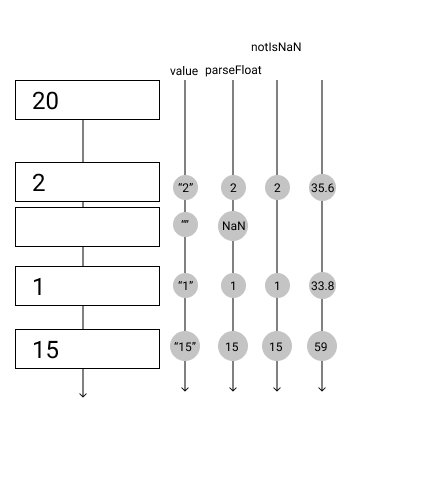

In the response to my tweet about these new diagrams, Antranig pointed me to the bidirectional lens work by Pierce, which is funny because I have his book right next to me. I am wondering how related the view-update database problem is to the child-to-parent update problem is in HTML UI design. I’m a bit worried they are the same problem and I’ve wasted all this time not realizing it. It would explain why nobody has been able to figure out end-user-created UIs: the view-update problem is critical and unsolved. I’ll need to look into this more…
March 4, 2019
- 2/28-3/4
- Sad Mantras
- Gametrail 3/4/19
- Lambda calculus on the brain
- Speaking of essential vs incidental complexity…
- Week of 3/4/19
2/28-3/4
I haven’t been very productive the last few days. I came down with a cold towards the end of Saturday. I did just an hour of researching Coda for Dark, organized the meetups, started a test Zulip, and published the JE podcast. Ok, so not nothing, but I really need to get back to my main research!
Oh, I forgot! I also read 14 chapters of TaPL on Friday. Not my focus but still worthwhile!
Sad Mantras
Sometimes I find sad mantras rattling around my brain. At one point it was “grass is always greener” when I was considering doing something else, but everything I tried was worse than what I was doing. Ultimately, I got over it and now feel that research is a great choice for me. I don’t salivate over other careers anymore or imagine them as rosier.
I do have a new mantra I’ve been trying to kick: “what do you have to show for your efforts?” I do have almost 40 podcasts. The Dynamicland essay and the LIVE bootleg. The Slack and a few meetups. A Twitter history. A very long research journal. A mediocre paper and presentation at REBLS. Another soon-to-be mediocre paper and presentation at the Salon de Refuge.
I want something polished and shipped that I can point to. I think my Hareactive/Turbine devtool could be it, but maybe I should consider hacking it together in the Bret Victor style of a cool demo, but not an actual usable tool. After all, I’m not sure Hareactive/Turbine is the end-all-be-all that I want to support. It’s more just a decent library I can use as a proof-of-concept.
Gametrail 3/4/19
I’m going to henceforth refer to the Hareactive/Turbine devtool as gametrail because of “hare” and it’s about following the paths of events and stuff. And “Hareactive/Turbine devtool” is too damn long.
One clear next step is from my last meeting with JE, where he suggested flipping the diagrams 90 degrees so that the flows flow downwards, which will allow the text more space. I think it’d definitely be worthwhile to re-do some of the mockups in this direction – though maybe I should hold off until I do one or two more of these in live HTML so I get a better sense for how they feel. I could do the next live HTML one vertically, too.
I also had a really wonderful call with Josh Horowitz about layout algorithms on the 15th of last month. I’ve been meaning to add it here. One key point he made was that if a layout specification starts to “feel like sudoku” than it’s probably undecidable and you need an algorithm for it, that’ll likely have unpredictable outputs. What if the user deletes one node and the whole thing rerenders? Clearly that’s not what we want. He made a really solid pitch for simple, mostly linear graphs, possibly in HTML with embbed shapes instead of in SVG with foreignObject text, with maybe a few wormholes here or there for the far-away branches.
In short, I need to go back to mocking up!
Lambda calculus on the brain
I finally bought Pierce’s Types and Programming Languages, TaPL from Stephen Diehl’s recommendation. I also bought PFfPL from Cyrus Omar’s recommendation, but haven’t gotten it yet.
After reading it all Friday afternoon, I thought about it a lot, particularly on my run yesterday (which likely helped get me sick). It got me wondering about how function substitution is so strange, including all the variable re-naming tricks we need to do to get closures to work. I also thought about how function scopes are super similar to objects/dictionaries. In other words, I was questioning the primacy of the functional approach.
Sometimes I think about how functions are really just constant expressions that you can reach into and tweak various parts of simultaneously. So they’re “linked constants” + “tweakable constants”. But I guess that doesn’t cover first-class functions which are a strange closure thing.
All these thoughts eventually brought me back to an idea I’ve had for the last few months: taking denotational semantics seriously for user interfaces. Define everything as a function from x, y, t, keyboard events, and mouse events.
Part of how I arrived at this idea was I was thinking about how complicated HTML child to parent communication is, which is what spent last Wednesday on, and is related to my convo with Josh about layouts. But I am wondering if the HTML / CSS box model is clouding my thinking, and was wondering if I went to the denotational basics, I could get to the bottom of the complexity here.
I thought about how to implement two input boxes, down to modeling the cursor as a rectangle. I didn’t get very far with this. I bet, just like with multi-tier languages, there is a whole research topic that pulls on this thread of “layout languages.” Of course there are the SAT Solver / cassuary things, but those run into the “sudoku solver” issues.
At the very least, I’d like to get to the bottom of the essential complexity of common, 7 GUI, interface problems, and see if I can express their inherent recursiveness elegantly.
Speaking of essential vs incidental complexity…
I’m beginning to get tired of these terms, because nobody ever defines complexity or points it out precisely. It’s always hand-wavy. I have a sinking feeling this is an issue.
Week of 3/4/19
Today was mostly a bust on account of the cold, but I did get the Zulip started, a bit of Coda research, and this log done. Tomorrow I will likely still feel sick, but hopefully I can get a few hours of work done, maybe Coda, email, or Gametrail mockups. I’d also like to get my meetups finished organized – as they are both very close to “done”.
add episode 37, je
Feb 27, 2019
Salon de Refuge 2019
I’ve spent a ton of time on this the past couple of weeks. It’s been a bummer because it’s time away from my Turbine devtools visualizations. But it’s not wasted time, for sure. I’ve learned a ton! Done a lot of research and firmed up my thoughts about things.
Yesterday I had a really wonderful conversation with JE about how to move forward, considering that my paper needs drastic improvements and reduction in scope. We considered a lot of things, but ultimately decided it could be good for me to explain how I became convinced of the original FRP paradigm, instead of trying to argue for it in the abstract. I spent all day today on it and put it on the dctp draft file, where I’ve been keeping all of this work. It may be silly but I didn’t feel like polluting this log with all those random notes.
Questioning the Salon
The past week I did a bit of traveling, and lost some work time there. I’ve also been feeling a bit bummed about working on this Salon essay instead of my Turbine visualizations. Part of me thinks I should just scrap the Salon essay, pull out, not go to >Programming< at all, and just focus on my devtools.
Otherwise, I only have 2 weeks before going to SF where I may not get much research done at all, then a week at home, and then >Programming<. Basically, I am worried that come April 8th, I will be right where I am now on my main research thread.
Instead of that, I could use those three weeks to make solid progress on my devtools visualizations.
Or I could zoom out and see this as a longer-term investment in my career as a researcher. I am getting myself out there, explaining what I am doing and why I think it important, and setting the state for interesting research in the future.
Also, I wonder how little work I can get away with. Maybe the presentation I came up with today is decent, only requires another few hours, and I can ask not to be published (or just allow my original piece to be published because who cares?). Jonathan will help me navigate this…
Week of 2/25 and 3/4
The rest of today will be random inbox tasks, such as organizing the London and SF meetups. Tomorrow is travel so I do not expect to get much work done.
Friday and all of next week is open. I want to work on:
- make progress on Turbine viz (30 hours)
- researching Coda for Dark (4-7 hours)
- organize London and SF meetups (4 hours)
- organize SF trip (2 hours)
- publish JE podcast (5 hours)
added readings, notes, and potential dctp draft 2
publish episode 36 tudor girba
added tudor essay and embed episode
Feb 12, 2019
Yesterday 02/11/19
After struggling to parse Turbine/Hareactive data structures, I sent Simon Friis Vindum an email to schedule a meeting for him to help walk me through it. He shot back a great question, asking for a “motivating example” of what I want to accomplish. I thought it’d take me just a couple minutes to sketch out the “target data structure” I’d like to parse out of Turbine, but I ended up spending all of yesterday, and likely more time this week on it.
I started with the simple counter app, and tried to manually instrument the required streams to visualize it. I ended up doing some random tricks to get it to work, but it was a super valuable exercise.

I’m excited to continue with this for the other 7GUIs projects, like the temp converter, timer, etc. Even my buttons that make buttons! I think it’d be a mistake to try to abstract too early here, but instead focus on the specific goal visualizations and eventually map backwards to a more general tool.
Some little things that I’ll need to work at some point:
- Getting arrows to rotate. I’ll probably want to use the
markersvg tag. - I’ll probably want the arrows to stay stationary and have the events move leftwards (to simulate the arrow moving), and give you the ability to scrub time somehow. I can then probably delete the pan and zoom stuff. I wonder if I’ll need some background context to make it clear the arrow is “moving”, such as a tickmarks on the timelines.
- I am curious how I’ll do layout algorithms for this diagrams in the general case. I shot a message to Josh Horowitz to ask what he did for Pane because he mentioned it was difficult but he came up with something good. I’m mostly curious about the laying out of boxes and arrows at a high level but this will also be interesting even at the smaller levels, of calculating pixels relatively for all things. One such thing that’s particularly important is laying out the text labels for Events, particularly when Events occur close together in time. The tooltip solution I have now is meager at best.
- Make a sharper distinction between how I treat Behaviors and Events. This will become more apparent for pull-based Behaviors… I should also strike up a discussion with Simon about how his push-based Behaviors are really Dynamics (from Reflex).
Note: I just had a great meeting with JE that cleared up some of these questions.
Future of Coding Meetups on the road
I have a lot of traveling the next few months. It’d be great to take the FoC Meetups on the road with me to these cities somewhere in these dates:
- March 1-14 London
- March 15-24 SF
- April 28-May 13 NYC
I think it’s worth setting aside time to plan this out, so I will maybe try to this over the coming weeks – sooner rather than later. I struggle so much with the format… dinner, drinks, at an office, or a bar/restaurant, presenting, etc, etc… I’ll ping around and think about it more…
Week of 02/11/19
Tomorrow I’d like to finally write the blog for and then release the Tudor Girba episode. I think it’d also be good to finish up JE’s episode and send over for transcription. Then maybe I should work on DCTP Todos.
Thursday I’m visiting the Vatican, and Saturday I’m doing more touristy stuff, so not sure how much work will get done then. Friday and Sunday are free. I have plenty to do (FRC, visualizer, meetups, DCTP essay), so I’ll just have to figure it out.
Feb 8, 2019
Woke up late, and only got a few hours of work in today. My girlfriend and I have been very active - running all four days we’ve been in Rome so far!
My DCTP paper was accepted into Salon de Refuge, which is a mixed blessing. It’s great that I know have to take the time to make the piece decent, but it’s also not what I was hoping to spend my time on right now… I’ll talk it over with JE and get his advice on decreasing the scope of the piece so I can get something good by the workshop on April 2nd. I’ll also have to prepare a talk too!
Turbine buttons that make buttons visualized!
My favorite cyclic and higher-order FRP example now has a very fun visual to go along with it:

Tufte-style polish
Glen was nice enough to read my last entry and make a very kind and helpful comment:
"These diagrams were initially disappointing." There is some visual design work you can do to make them clearer. First by organizing things spatially along a grid, and then by using colors and line/font weights to create layers a la Tufte: pic.twitter.com/ShIvO55I3s
— Glen Chiacchieri (@Glench) February 7, 2019
This is a really great point. My diagrams thus far have been created about as fast as possible while trying to get 80% of the details right. They are basically pencil and paper sketches, but done on the computer.
While part of me thinks it’d be fun to try and get these sketches pixel perfect, I worry that is a longer task, and I’d be better served right now inspecting the Hareactive/Turbine stream data structures to get a better sense of what I’ll be able glean from them to then visualize. Then once I have a better idea of what’s possible, I may come back and try and make these pictures clearer and more accurate.
Feb 7, 2019
Last week till now 02/07/19
I spent a bit more time Thursday last week visualizing single Hareactive events and behaviors. I spoke with JE and he thought I was roughly on the right track. I came up with a simple pan-and-zooming interface and had this wacky idea that we could simply shrink a large object so you’d have to zoom way in to see the values. But then I got bogged down in SVG text layout algorithms and gave up. I felt like I was losing the forest for the trees.
Friday was devoted to researching mbeddr for Dark, which was fun. I watched a bunch of their videos, got it installed, messed around, and, even read a few papers they published. I then finally printed out and read most of Cognitive Dimensions of Notation, which I realized was an instant classic, and I then spent an hour trying to compile a list of “classics.”
On Saturday, I recorded a very long in-person conversation with rntz, which was fun but also exhausting due to the length. It was a fun, math-heavy conversation. I recorded it on my new H4N mic where each of us was speaking into one of the stereo mics, which I think came out OK.
On Monday, my girlfriend and I flew to Rome for more sunshine in our lives, so I didn’t get any work done.
Tuesday morning was working on mbeddr for Dark. (I have been scheduling these Dark presentations every 3 weeks or so to give me more time for other work. The next two will be Coda and Retool. Maybe I’ll be in SF in March to give one of these in person!)
Yesterday and today were mostly research and I got a decent bit done, mostly in pencil and paper and Figma…
Turbine Viz Sketches
After getting lost in the weeds with text layout last week, I realized that I’d be better served prototyping in diagrams first rather than code, so I tried my hand at visualizing the first few 7GUIs tasks.

I should probably put { ... } or DomEvent { ... } as the values in the first line of the counter but I guess I forgot. Besides that it seems to make OK sense. It’s a bit weird that the 7 is at the bottom but it appears next to the count in the diagram, but that could be solved in a few different ways, for example putting the 7 where it belongs and sending an arrow up to it.

The temp converter has a nice parallel structure, but then there’s that awkward 3rd-and-4th switch over on each side. One possible way to simplify this is by only computing C (by converting F to C, combining, and stepping) and then mapping over that Behavior to get back to F. But it’s really half a dozen of one or six of the other…
I experimented at the bottoms with heights as a function of magnitude, which I think came out nicely. The loops at the bottom make reasonable sense. The main thing I dislike about this example is that newValue at the top and setValue at the bottom feel very imperitive, breaking the nice denotations, but I guess that’s kind of unavoidable given the way the HTML DOM works…
For the temp converter, I also tried an alternative with timelines that all line up that didn’t quite come together.


The flight booker was a fun. Here I experimented with a few different ways to display Behaviors. All the way to the right, I have a Behavior that’s always true and it’s simply a line with a T over it. Then down at the bottom-left corner, I have a Behavior that’s switches between T/F a few times, with hard lines between switches, and soft dotted-lines between where computations occurred but returned the same value as before. In the actual prototype you could imagine hovering over that place to see the computation that occurred there. (However, as I reflect on it now, this diagram might reflect the implementation detail that these behaviors are push-based too strongly…) One interesting note: I realized while making this diagram that the keepWhen function is a better use that what I actually had in the code (filterApply).
I don’t mind that the GUI elements are spread out haphazardly on the canvas here, as long as elsewhere I can see them in the order that they appear on the page. Another possible interface is to not have them rendered in the SVG at all, but when you hover over them, it’ll light up in the respective GUI, much like the HTML devtools inspector.
This is also the first time I experimented with putting a lot of code (for the lift in the bottom-left) on the screen. It doesn’t quite make sense in context (I just copied and pasted), but it’s a reasonable placeholder. In the first version of the prototype, this will not be possible, because we won’t have access to the source code.
The loopy bits for the background colors of the textboxes is pretty straightforward. I like how that came out much, much more than with the temp converter, because setting the background color to a Behavior feels more semantic.

It was fun to work with time and higher-order flows. I simplified this diagram by assuming access to a “seconds since the app started” stream that you see in the top-right and bottom-left. Like the last example, I put some “filler code” for the snapshotWith that won’t be possible in the prototype.
The higher order stream came out well. I think it’s important to keep them lined up the way I did for clarity. I don’t know if it’s obvious that the third stream is always 5.7. Maybe I should put the dotted line markers at 5.7 throughout and put the 5.7 at the end as well? The dotted markers are an interesting trick, but there’s also the step-function approach. And here’s another idea: number lines with firm line markers usually represent continuous numbers, but that’s how I’ve been representing Events. Maybe I should represent events as circles with no line (or a really stylized / faded line) and leave the timeline to Behaviors…
Deep diagrams
These diagrams were initially disappointing. Even when I look at them, they are immediately intimidating, even off-putting. They don’t yield to insights in 3 seconds, like many other visual aids do.
However, upon reflection, I thought about how many of Tufte’s diagrams take many minutes of study to fully grasp, and then even more time to mine for interesting insights. So while these diagrams might take 30 seconds or 5 minutes to comprehend, that’s an order of magnitude better than an hour or two to understand the code. And they will likely be helped along by liveness when they are connected to GUIs that can be interacted with, turning the crank on these diagrams.
Next steps 02/07/19
I’m going to finish preparing for my mbeddr presentation for Dark in 3 hours tonight. Tomorrow and Monday I will try to continue pushing this work forward for my meeting with JE on Monday, maybe switching to coding some of this up… I’d like to do a visualization of my buttons that create buttons example before that.
As far as next steps on coding, I’d like to go high level and see what I can inspect/crawl out of Turbine stream and component data structures to turn into the diagrams above. Then I’ll combine the low-level work from last week with this high-level work to have beautiful diagrams! (I also need to do a bunch of refactoring with last week’s code. It was getting a bit annoying working with SVG in the way I was. I am wondering if I should build an abstraction over SVG that converts it to a normal X-Y plane…)
I think Tuesday next week would be a good time to finally publish the Tudor Girba podcast, and finish editing the JE podcast and send it off for transcription.
Wednesday could be a good time for some FRC work. Thurs and Friday I’ll plan on getting back to working on the research.
Update from Forestry.io - Updated Forestry configuration
Jan 30, 2019
- Podcast update 1/30/19
- Balance update 1/30/19
- Call with Simon Friis Vindum
- Turbine devtool
- Ink and Switch
Aaaaaaaand, I’m back! It’s been too long since I’ve done research and a proper log entry. Instead of struggling through getting set up with working on Hareactive/Turbine, I thought it better to wait until I spoke with Simon, and use the waiting time for other work, such as freelancing and the podcast. I’ve also been obsessed with the Sword of Truth series on audio-book, so that’s to blame as well.
Podcast update 1/30/19
As far as the podcast goes, it’s been productive:
-
The Tudor Girba episode is ready to go, including the transcript, but I just need to write a summary blurb at the top and then publish and submit to HN.
-
The JE episode is edited. It just needs an intro and outtro, transcript and blurb.
-
I recorded an conversation with Cyrus Omar
-
I am speaking with with Michael Arntzenius in person on Saturday!
This will leave me with plenty of podcast editing and publishing to do in February in Rome. (My girlfriend and I are headed to Rome for ~3 weeks for more sunshine in our lives. And Italian food, of course.)
Balance update 1/30/19
I’ve been doing a better job of balance than in the past. My only remaining problem is that it’s a bit difficult to decide when to do what, and when to switch. I’ve noticed that I get most of my research work done in the days before meeting with JE, and most of my work for Dark done in the days before meeting with Dark. I don’t often meet with FRC, so I sometimes forget about them, but I have two active projects for them that are waiting for whenever I have the time…
I’m glad I did the research on Modern Smalltalks for Dark. It was fustrating at the start, but well worth it at the end. Dreading doing it for mbeddr and TLA+ but I know I’ll be thankful afterwards. The plan is to spend all of Friday on Dark stuff.
Yesterday, today, and tomorrow are research so as to have impressive things to show and tell to JE tomorrow.
Next week will be Dark, FRC, and some research, some podcast.
Call with Simon Friis Vindum
I finally got Simon on the phone! It’s been a number of weeks of waiting for him to finish up with his exams. He was wonderful. We chatted for ~2 hours, first about a few issues I opened on his projects, then about the devtool, and finally I shared my screen and he help get me set up in the right code environment and got started adding SVG elements to the Turbine library.
One issue he mentioned with the devtools is that intermediate stream variable names don’t get captured in any data structure, so people will have to figure those out from context.
We also talked a bit about how push-based might has a memory leak problem because parents have references to children, that otherwise would be garbage collected.
Turbine devtool
Finally the rubber is hitting the road! It’s awesome to see this coming together in a real live project at long last. Simon and I came up with a plan for moving forward:
- Add SVG elements to Turbine. Done, pending fixes and merge.
- Create a visualization for a simple number stream. Done this morning.
- Visualize push-based stream (label between intervals)
- Visualize pull-based stream (constantly sample and maybe graph)
- Visualize non-numbers
- Visualize data structure dependencies, starting with map…
- Visualize higher order…
- Visualize cyclical…
- Visualize Turbine/HTML-based streams
- Use the devtool to finish 7GUIs (add types?), and submit a pull req for that.
- Write a paper/presentation/video about the devtool
I realized this morning about all the important little things I need to figure out now, such as dynamically displaying all the stream data. I settled on the fastest solution I could think of: simple arrow based pan and zoom. I wonder if I should go extreme with it and just make the font of large objects really tiny and you can zoom in to see their properties. That’d work as a placeholder.
I feel myself already wishing to “eject” from a devtool, so I can do cool things, such as when you hit space, it pops open a box where you can search for operations like in Facebook origami. But instead you can type, with autocomplete, various flow names and it’ll suggest flow combinators based on their types, and supply default arguments, and show the output flow as you scroll through the options. Or maybe the options are the output flow!
Ink and Switch
Last week I met with the Ink and Switch team. It seems like it’s former Heroku people doing research towards a company a la Dark. It was really fun! I just got off a call with pvh from their team. He showed me their farm software. So cool! He was repeating back my whole mission back at me! He calls it “Personal Software”. They are using it at their company - right now it’s a dashboard of a todolist, personal updates, a chat thing. It’s living! Amazing! It makes me think that the day will come soon when personal software is upon us. I can already imagine moving the Future of Coding Slack to a platform like this… Very cool!
Their underlying technology is similar to dat/beaker/scuttlebutt/ifps. pvh had to explain how the internet works to me, Nat, UPD, WebRTC, etc, for me to follow. It’s build on top of a JSON CRDT so that it causes the least conflicts. It’s a peer to peer data model, and
added ink and switch presentation
add dctp draft 1 feedback, and responses
added episode 36 tudor transcript
add animation examples to dctp essay
continuing writing, conal elliott war cry
Jan 17, 2019
Some quick updates:
- Realizing I got the year wrong on the title of my last entry. It’s 2019, not 2018!
- Feeling great! At coffee shop with my girlfriend today for a change of scenery.
- Just got back from a 4 day trip to Rome. Great vacation. Got some sun, had great tomato sauce and pasta, relaxed, and Tweeted. We may go back for a longer trip (a couple of weeks) to live and work there for the sun and food while London is gloomy.
- London is sunny today so I will run this afternoon.
- I had a wonderful call with Conal Elliott on Monday. Along with JE’s prodding, I decided to try my hand at an essay explaining DCTP and Conal’s vision, and maybe submit to Salon de Refuge.
- Great call with JE yesterday. Going to continue with hareactive, turbine, etc, but mostly waiting to talk to Simon Friis Vindum and team after their exams are finished on the 25th of Jan. Making a hareactive canvas library sounds fun. JE also suggested finishing 7GUIs and the devtools together which is a great idea.
- Spent a good amount of last week researching Smalltalk for Dark, which I hope to publish at some point. Will need to figure out with them when the next session will be. Maybe in two weeks? Maybe TLA+?
- Excited to host an online FoC meetup Sunday night GMT. Not sure how to structure it… will figure something out…
- For more of what I’m working on, head over to the Github board
add JE notes 01-16-19
added conal call notes
Organizing my work on 1/6/18
Haven’t journaled in a while. Moved a lot of this thought to Github Issues which I don’t love to be honest but it works ok.
Feeling like progress is slow. Resisting working on podcasts. Feels like busy work. But I should probably knock it out.
Also resisting working on Dark but it’d probably make me feel great to install one of those and spend 4 hours on it. Maybe tomorrow.
Ok let’s say today is publish Vlad.
Tomorrow is 4 hours Dark.
Maybe Tuesday I can do Turbine 7GUIs. Maybe just keep with Dark if I have momentum.
Wednesday another 4 hours Dark or 7GUIs or prep JE.
Thursday is prep for JE. 4 hours should do it. Maybe find time to start earlier in the week too.
Let’s say no Tudor podcast work this week. No rush there…maybe let’s hold off scheduling next podcasts (Cyrus and Hillel) until Feb and am through publishing Tudor and JE. I’ve got enough on my plate with Dark back in the mix and Tudor’s 3 hour podcast. And all the P4 work! (And the community! And FRC!)
Ok so this week, the priorities are:
- Prep JE
- Dark
- Vlad publish
Let’s say no FRC, Turbine/P4, community, Tudor (but that just means only if I really want to). Ok now my week feels reasonable. For Dark, I’ll try with whatever feels easiest and keep switching until I’m mostly done with one. Maybe Pharo and GT because Tudor may help me?